
For nearly a decade, signing up for Carta was treated as an unavoidable rite of passage for venture-backed founders. Incorporate Delaware C-Corp, open Silicon Valley Bank or Mercury account, sign up for Carta. It was the standard playbook preached by accelerator directors, law firms, and seed funds alike.
Yet over the last two years, sentiment among early-stage founders has shifted from quiet resignation to open revolt. Pre-seed and seed founders are asking a fundamental question: Why are we paying $2,000 to $3,500 every single year just to record three angel SAFEs and an unallocated stock option pool? According to data from the NVCA / PitchBook Venture Monitor, over 80% of early-stage financings now close via standardized post-money SAFEs without requiring multi-tier institutional preferred stock.
This recurring expense has earned a bitter moniker in venture circles: the "Carta Tax." And for modern startups operating in an era where capital efficiency and runway preservation are paramount, burning thousands of dollars annually on software logged into twice a year is no longer an acceptable cost of doing business.
The Anatomy of the Carta Invoice: What Are You Really Paying For?
To understand why early-stage founders are moving away from legacy cap table platforms, one must look closely at how those platforms monetize. Carta originally captured the market with a freemium offering for companies with fewer than 25 stakeholders. Once market dominance was secured, that low-cost tier was quietly phased out, replaced by mandatory annual minimums and aggressive sales cycles.
When a pre-seed startup requests a quote today, the standard introductory plan typically starts between $1,800 and $2,400 per year. As soon as you add advisors, grant options to your first two software engineers, and issue SAFEs to five angel investors, your stakeholder count crosses arbitrary thresholds that trigger automatic tier upgrades.
Consider the real-world math for a typical pre-seed company:
- Two Co-Founders: 2 stakeholders.
- First Three Hires: 3 stakeholders holding stock option grants.
- Angel Round: 6 angel investors who contributed $25k checks on YC Post-Money SAFEs.
- Legal Counsel & Board Advisor: 2 stakeholders.
With just 13 total entities on your cap table, you are suddenly paying hundreds of dollars per active stakeholder per year. You are essentially paying enterprise SaaS rates for a glorified spreadsheet that tracks static ownership percentages. Furthermore, if you need to run scenario dilution models or simulate preferred stock liquidation preferences for your upcoming Series A, legacy platforms often demand that you upgrade to premium enterprise tiers.
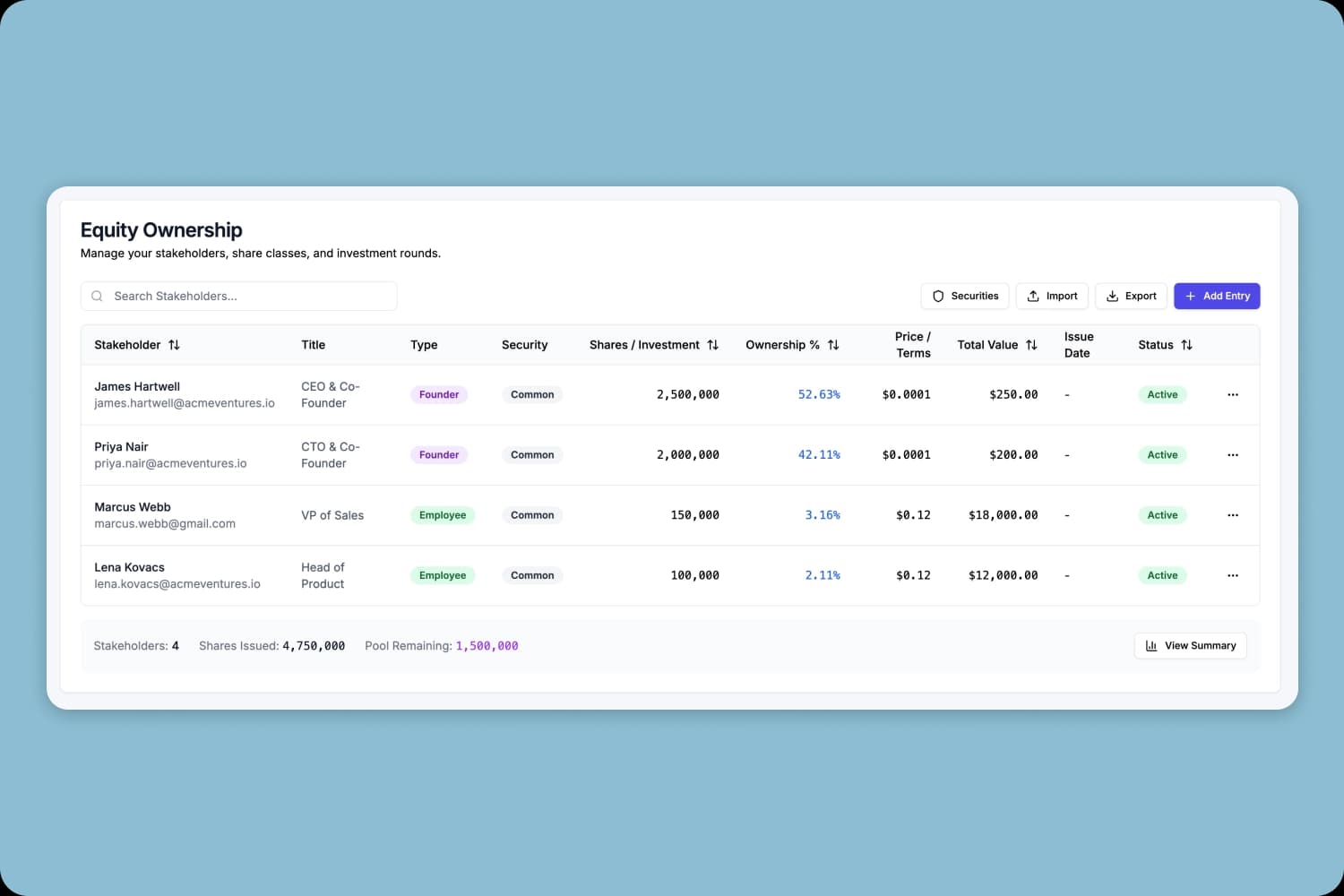
The Structural Disconnect: Siloed Cap Tables vs. Active Deal Rooms
The frustration among venture founders is not solely about price. It is about how modern fundraising actually happens in practice.
When you raise capital, your capitalization structure is not an isolated administrative chore—it is the central asset of your diligence process. Yet traditional tools force your fundraising stack into disconnected silos that do not talk to each other:
- Your Pitch Deck Lives in DocSend: Costing you $150 to $250 per month just to track investor link views and slide-by-slide completion rates.
- Your Equity Records Live in Carta: Costing you $2,000+ per year locked into an auto-renewing 12-month contract.
- Your Diligence Docs Live in Google Drive: Vulnerable to accidental link forwarding, permission mistakes, and zero audit logging.
- Your Monthly Updates Live in Visible.vc or Substack: Costing another $50 to $100 per month just to email KPIs to your current backers.
This fragmentation creates severe operational friction. When a prospective lead venture capitalist finishes evaluating your pitch deck and asks to see your capitalization table, what happens?
In the legacy paradigm, founders scramble. You either export a raw Excel spreadsheet from Carta and attach it to an unencrypted email thread—immediately exposing sensitive founder equity splits, employee salaries, and angel valuation caps—or you pay Carta an exorbitant add-on fee to access their standalone virtual data room (VDR) module.
Founders are forced to play systems integrator between three or four disparate platforms, paying redundant subscription fees while introducing massive security vulnerabilities into their deal pipeline.
What Early-Stage Founders Actually Need vs. Enterprise Bloat
Carta was engineered to solve the administrative challenges of late-stage, pre-IPO tech giants with thousands of employees, complex secondary liquidity tender offers, and multinational tax jurisdictions. But over 90% of venture-backed startups are pre-seed, seed, or Series A.
At these foundational stages, founders do not need secondary market liquidity engines. They need three core equity capabilities executed with institutional rigor:
1. Fast, Bulletproof SAFE & Convertible Note Tracking
Virtually every early-stage tech round today is raised using standardized instruments: Y Combinator Post-Money SAFEs (with valuation caps or discount rates) or convertible promissory notes. Founders must have complete mathematical clarity regarding how multiple SAFE tranches convert upon a priced equity round.
When you take a $250k check at a $6M post-money cap and another $500k check at an $8M post-money cap, how much dilution do the founders actually absorb? What is the effective share price upon conversion? DealVue calculates these mechanics automatically, eliminating the dreaded spreadsheet calculation errors that derail legal diligence.
2. Institutional Preferred Stock & Exit Waterfall Modeling
When your company graduates from SAFEs to a priced Series A round, financial complexity increases exponentially. Institutional VCs do not buy common stock; they negotiate for Series A Preferred Stock.
Preferred stock term sheets introduce terms that radically change founder outcomes at liquidity:
- Liquidation Preference Multiples: 1x non-participating preferred (standard) versus 2x or 3x participating preferred (aggressive downside protection).
- Seniority Structures: Whether Series A sits senior to future Series B investors, or whether all preferred classes share pro-rata (pari-passu).
- Compounding Cumulative Dividends: Annual dividend rates (e.g., 6% to 8%) that compound over time, increasing the investor's priority cash claim before common shareholders receive a single dollar.
Founders should never have to pay thousands of dollars to an external advisory firm or fractional CFO just to model how much money they will take home in an acquisition. With DealVue's built-in Exit Waterfall Simulator, founders can slide through exit valuations from $5M to $150M and visualize the exact distribution of proceeds across every shareholder class in real time.
3. Application-Level Encryption (ALE) & Stakeholder Privacy
A startup's cap table contains the most confidential proprietary numbers in the entire company: co-founder equity splits, executive option packages, seed check sizes, and internal valuations. Leaking these numbers can destroy team morale, ignite co-founder disputes, and compromise upcoming term sheet negotiations.
Legacy cloud platforms store cap table data in standard multi-tenant databases with disk-level encryption. If an unauthorized administrator or bad actor breaches the database layer, the underlying tables are readable in plaintext.
DealVue operates on an Application-Level Encryption (ALE) architecture using AES-256-GCM. Individual stakeholder fields—names, share quantities, valuations, and investment amounts—are encrypted in application memory before being written to disk. Even if the underlying database were physically compromised, your equity ledger remains indecipherable ciphertext.

4. Scoped Stakeholder Portals
Another critical flaw of traditional equity tools is all-or-nothing visibility. If you grant an angel investor or an employee access to view their shares, they often gain visibility into other shareholders or the aggregate valuation of the company.
DealVue provides Scoped Stakeholder Portals. When an advisor, early employee, or angel logs in, they see only their verified equity grants, personalized vesting schedules, and projected payouts. They cannot view confidential co-founder allocations, other investors' check sizes, or company-wide balance sheets. You maintain total transparency with your stakeholders without compromising corporate privacy.
Head-to-Head Comparison: DealVue vs. Carta vs. Legacy VDRs
To see how the economics and feature capabilities compare, review the side-by-side matrix below:
Feature / Dimension | DealVue Business ($79/mo) | Carta Core ($2,000+/yr) | DocSend + Excel |
|---|---|---|---|
| Annual Software Cost | $948 / year ($79/mo) | $2,000 to $3,500+ / year | $1,800 to $3,000 / year |
| Contract Commitment | ✓ Month-to-month, cancel anytime | ✗ Mandatory 12-month lock-in | Annual or monthly |
| Integrated Investor Data Room | ✓ Included (Unlimited rooms) | ✗ Separate paid add-on ($1,500+/yr) | ✓ Included (DocSend rooms) |
| YC Post-Money SAFEs & Notes | ✓ Included | ✓ Included | ✗ None (Manual spreadsheet) |
| Exit Waterfall Simulator | ✓ Included (Multi-tier modeling) | ⚠️ Requires paid upgrade | ✗ None |
| Scoped Stakeholder Portals | ✓ Included | ✓ Included | ✗ None |
| Application-Level Encryption (ALE) | ✓ AES-256-GCM zero-knowledge | Standard disk encryption | Standard disk encryption |
| AI Diligence Co-Pilot (Clara AI) | ✓ Included (7-agent review) | ✗ None | ✗ None |
| Carta CSV Importer | ✓ 60-second automated mapping | ✗ N/A | ✗ N/A |
The 3-Year Runway Impact: Saving Over $9,000 in Overhead
Early-stage founders often treat small software subscriptions as negligible line items. But when you aggregate the typical seed fundraising toolchain over a 36-month horizon between incorporation and Series A, the cumulative financial drain is staggering:
- Carta Core Plan: $2,200/year × 3 years = $6,600
- DocSend Advanced: $150/month × 36 months = $5,400
- Visible.vc Investor Updates: $50/month × 36 months = $1,800
- Total Traditional Stack Cost: $13,800
Now consider the same 36-month timeline on DealVue:
- DealVue Launchpad (Pre-Seed Months 1–6): $0 (Free forever)
- DealVue Founder (Active Seed Raise Months 7–18): $19/month × 12 months = $228
- DealVue Business (Post-Seed & Series A Months 19–36): $79/month × 18 months = $1,422
- Total DealVue Stack Cost: $1,650
That is a direct capital savings of over $12,000. In an early-stage startup, $12,000 pays for three months of customer acquisition experiments, an essential server cluster, or two months of an offshore engineer. Burning that capital on redundant SaaS subscriptions does not help you build a better product or win customers.
How to Migrate Your Cap Table in 60 Seconds
The single biggest factor keeping founders locked into expensive legacy software is the perceived switching cost. Founders assume that moving equity records requires days of manual data entry, complicated legal audits, and hours of administrative headache.
To eliminate this friction, DealVue built an automated Carta & Excel CSV Parser that completes migration in three simple steps:
3-Step Carta Migration
Step 1: Export Your Data from Carta
Log into your existing Carta account, navigate to the Cap Table tab, and click Export Cap Table Report (CSV). No special formatting is required.
Step 2: Upload to DealVue
Open DealVue's Cap Table Management tab and drop your CSV file into the importer. The parsing engine automatically detects shareholder names, equity classes, SAFE investment amounts, valuation caps, and option grants.
Step 3: One-Click Confirmation & Encryption
Review the mapped summary table. Click Confirm Import. DealVue automatically applies AES-256-GCM Application-Level Encryption to all stakeholder records. Your cap table is instantly active, modeled, and ready to share inside your VuePort deal room.
Conclusion: The Future of Fundraising is Unified
The era of unbundled, hyper-expensive point solutions in venture capital is drawing to a close. Founders no longer have the appetite or the budget to pay multiple disconnected vendors for tools that belong in a single unified workflow.
By unifying pitch deck link analytics, dynamic security watermarking, investor deal rooms, and encrypted cap table management into a single platform, DealVue eliminates the Carta tax and empowers founders to move from fundraising chaos to total control.
Written by
Tim Wolter
Founder & CEO of DealVue · SafetyVue Founder · Peachscore Alum · EIR at Amplify Louisville · Author of The Last Year
Ready to eliminate the Carta tax?
Import your cap table in 60 seconds and start sharing your investor data room today. No credit card required.