
Clara reads your entire data room — pitch deck, financials, cap table, and governance documents — and synthesizes a full-spectrum investment memo that stress-tests your thesis against market physics. See exactly how your deal reads from the other side of the table. Before you walk into the room.

Every founder thinks their pitch is clear. Every investor has seen a hundred pitches that weren't. The gap between how you see your deal and how an investor reads it is where rounds get lost.

You pitch. Then you wait.
You send the deck, share the data room, and go silent. Three days later you follow up and still don't know if they were impressed or unconvinced. You're guessing at what they thought while they're already moving on to the next deal.

You can't see your own blind spots.
Every founder is too close to their own company to read it the way an investor does. You know the context behind every number. They don't. What feels obvious to you reads as a gap to them — and you won't know until they tell you in the meeting, if they tell you at all.

By the time you get feedback, it's too late.
Investor feedback comes after the pitch, after the meeting, after the pass. At that point the deal is already lost. The only feedback worth acting on is the feedback you get before any investor sees your room.
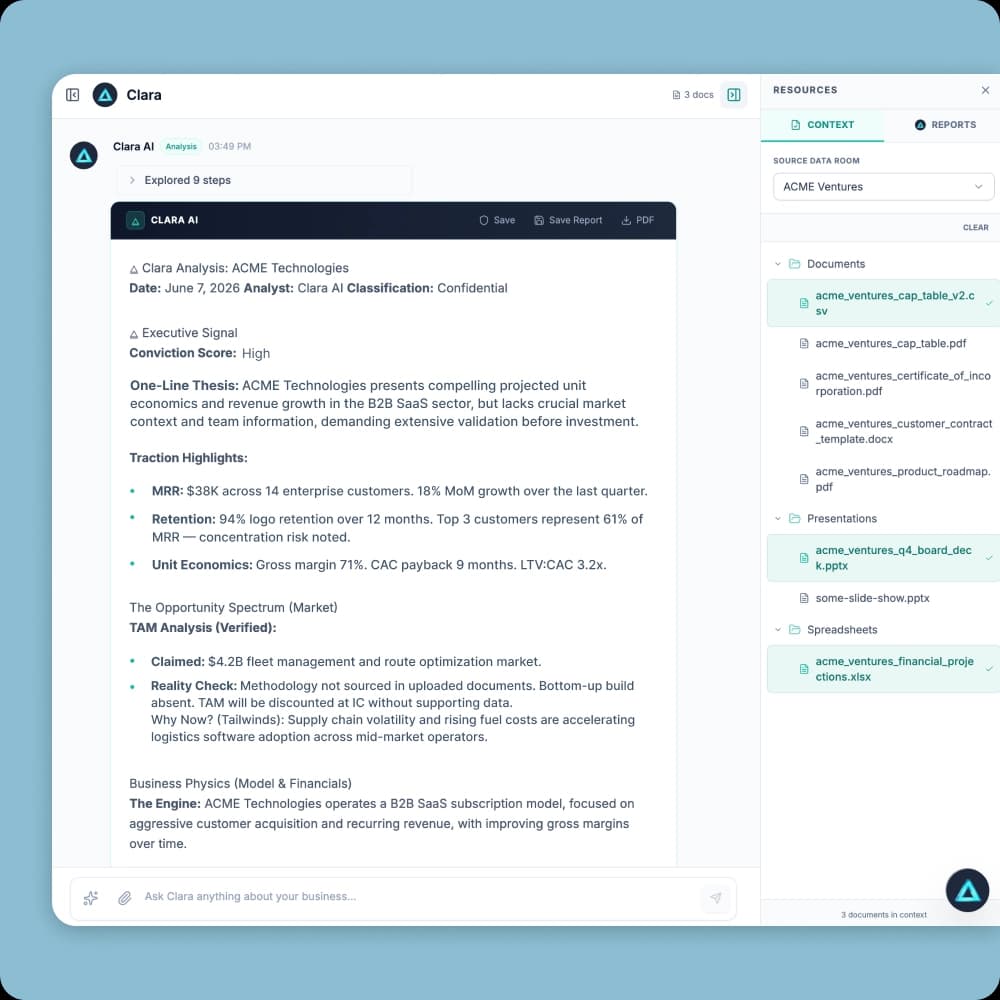
It's the memo an investor would write about your company after reviewing your data room. Clara generates it from your uploaded documents — and you get to read it before any investor does.
When an investor finishes reviewing your data room, they write an internal memo. It covers your strengths, your risks, your market position, and whether your thesis holds up under scrutiny. That memo determines whether you get a second meeting, a term sheet, or a pass. You've never seen it. Until now.
Clara reads every document in your data room — pitch deck, financial model, cap table, governance docs — and writes that memo for you. Not a version of your story told back to you. An investor's analysis of your deal, stress-tested against the five criteria institutional VCs use to evaluate every company at your stage.
Read it before your next investor meeting. Fix what needs fixing. Walk in already knowing the questions they'll ask — because Clara already asked them.
Clara's Investment Memo covers every dimension an institutional investor evaluates during diligence — organized, sourced, and stress-tested so you know exactly where you stand before the conversation starts.

Financial Signal Summary
Health score, capital efficiency assessment, unit economics evaluation, and burn discipline rating — all derived from your uploaded financials.

Thesis Alignment
How well your deal maps to the stated investment criteria for your stage. Where you fit, where you don't, and what the gaps mean for your raise.
Key Considerations & Risk Flags
The specific concerns an investor would raise in IC — sourced directly from your documents, not invented. Every flag includes a plain-language explanation of why it matters.

Team & Founder Assessment
How Clara reads your founding team against the domain expertise and execution track record investors expect at your stage.

Market & Competitive Position
TAM credibility assessment, competitive landscape evaluation, and defensibility analysis. Does your market narrative hold up under scrutiny?

Venture Validation Checks
Five institutional VC heuristics applied to your thesis — capital efficiency, market credibility, valuation defensibility, raise structure, and dilution logic.

Prepare like you've already been to the meeting.
Read the memo Clara generates before your next investor conversation. You'll know exactly which risks will come up, which strengths to lead with, and which gaps to address before they become objections. Walk into every meeting already knowing what they're thinking.
Pre-meeting preparation — know the questions before they're asked
Pitch refinement — identify narrative gaps before investors do
Data room improvement — use risk flags to prioritize what to upload next

Every inbound deal arrives pre-analyzed.
In the Command Room, Clara generates an investment memo for every deal in your pipeline — synthesized from the founder's data room before your associate reads page one. Faster diligence. Sharper IC conversations. No re-reading the same deck twice.
Pre-meeting deal review — Clara's memo replaces the first analyst pass
IC preparation — structured memo maps directly to your investment committee format
Thesis alignment scoring — see how each deal fits your mandate before the call
The biggest risk with AI-generated analysis is fabrication — confident-sounding claims with no basis in your actual data. DealVue eliminates this with Clara's fact provenance architecture. Every assessment in your Investor Memo is sourced directly from your uploaded documents. Every flag, every strength, every risk assessment links back to the specific file it came from.

Sourced at the document level
Clara identifies which specific file each claim came from — pitch deck, financial model, cap table, or governance document. You can trace every memo statement back to its source.

No shared context pools
Clara processes your documents in an isolated, credential-scoped session. Your financials are never mixed with another company's data. The memo reflects your deal only.
Zero model training on your data
Your documents are never used to train any model. Clara reads, synthesizes, and forgets. Your data stays in your tenant.
Holy shit! DealVue is amazing. Clara, the AI, gave incredible insight and a slide-by-slide analysis of my deck that was spot on. It even identified specific gaps in our founding team's background that I hadn't explicitly addressed yet. It pretty much mirrors my own analysis of my own strengths and weaknesses.
![[background image] image of founder at work (for an interior design firm)](/_next/image?url=%2Fimages%2Fben-reno-weber.webp&w=3840&q=75&dpl=dpl_4BQwusuMVdeJLS3rcBtcEuhRhfmz)
Upload your documents. Clara classifies every file, flags every gap, and gives you the four-pillar structure institutional investors expect — before anyone asks for access.
We use analytics cookies on our marketing website to understand traffic and improve DealVue. Analytics cookies are never loaded inside your secure Data Room. Cookie Policy