
Community Development Financial Institutions (CDFIs) and state economic development programs have a unique advantage: they have access to founders that traditional VCs never see. From rural entrepreneurs to underrepresented founders and those building outside major coastal hubs, these programs are tapping into a massive pool of raw potential. Yet, a significant gap remains between discovering these founders and getting them funded.
Over the past decade, there has been a widespread push to decentralize venture capital. Initiatives aimed at supporting minority, women, and rural founders have sprung up across the United States. State economic development agencies have poured millions of dollars into non-dilutive grants, regional accelerators, incubators, and pitch competitions. Despite this massive influx of top-of-funnel support, the conversion rate from "promising local startup" to "venture-backed technology company" remains stubbornly low outside of major tech ecosystems like Silicon Valley, New York, and Boston. According to recent industry reports, nearly 75% of venture capital still flows to just four major metropolitan areas.
Why does this disparity persist when the talent is clearly distributed evenly across the country? The issue is rarely a lack of hustle, ambition, or product-market fit. The true bottleneck happens during the transition from the community support ecosystem into institutional due diligence. Founders are being trained on how to pitch, how to build a deck, and how to tell their compelling story on stage, but they are rarely equipped with the backend infrastructure required to actually close a deal when a lead investor says, "Send me your data room."
The Missing Link: Infrastructure and Professionalism
Many of these founders never become truly fundable, not because their ideas lack merit or their businesses lack traction, but because they are missing the infrastructure, intelligence, and professional presentation that institutional capital expects. When a VC reviews a deal, they look for signals of competence and organization. A scattered Google Drive folder or a poorly structured financial model can kill a deal before the pitch even begins.
Defining the Institutional Funding Gap
The funding gap for underrepresented and rural founders is often framed as a network problem—the assumption is that they simply don't know the right investors. While network access is undoubtedly critical, it is only half of the equation. The other half is the "institutional funding gap." This gap describes the stark discrepancy between how a founder organizes their company internally and the highly stringent compliance, legal, and financial standards demanded by institutional capital.
For an economic development startup ecosystem to successfully funnel founders toward venture capital, it must provide more than just grants and generic advice. It needs to provide the professional infrastructure that fundamentally levels the playing field. When an investor evaluates a startup, they are ultimately assessing risk. An unorganized data room, missing intellectual property assignments, or a convoluted cap table introduces massive operational risk. For a venture capitalist managing institutional money, fixing a startup's operational debt is simply not worth their time when they have ten other deals in their pipeline that are neatly organized and ready to close immediately. The harsh reality is that investors will often pass on a good company with bad organization in favor of an okay company with excellent organization.
What Does "Fundable" Actually Mean?
In the context of venture capital, "fundable" is a highly specific operational state. It is not just about having a great product. It means that a company can withstand rigorous legal, financial, and technical due diligence without revealing major red flags. A truly fundable company possesses:
- Legal Readiness: Clean intellectual property assignments from all founders, contractors, and employees. Proper incorporation, usually as a Delaware C-Corp, with all state franchise taxes paid and up to date.
- Financial Readiness: A well-maintained capitalization table with properly documented equity issuances, no "dead equity" held by absent co-founders, and Section 83(b) elections filed on time. Financial models and historical statements that trace back directly to verified banking data.
- Operational Readiness: Organized corporate governance documents, including board consents, bylaws, and clear employment agreements that comply with local labor laws.
Founders from non-traditional backgrounds often learn about these stringent requirements entirely too late—usually during their first real diligence process, which frequently results in a lost deal or heavily predatory terms. By the time an investor asks for this documentation, it can take weeks and tens of thousands of dollars in emergency legal fees to clean up the mess. For CDFIs, university tech transfer offices, and state accelerators, the overarching goal should be to push this operational maturity to the very beginning of the founder's journey, embedding it into the company's DNA from day one so they are always ready for capital.
Embedding AI-Powered Tooling
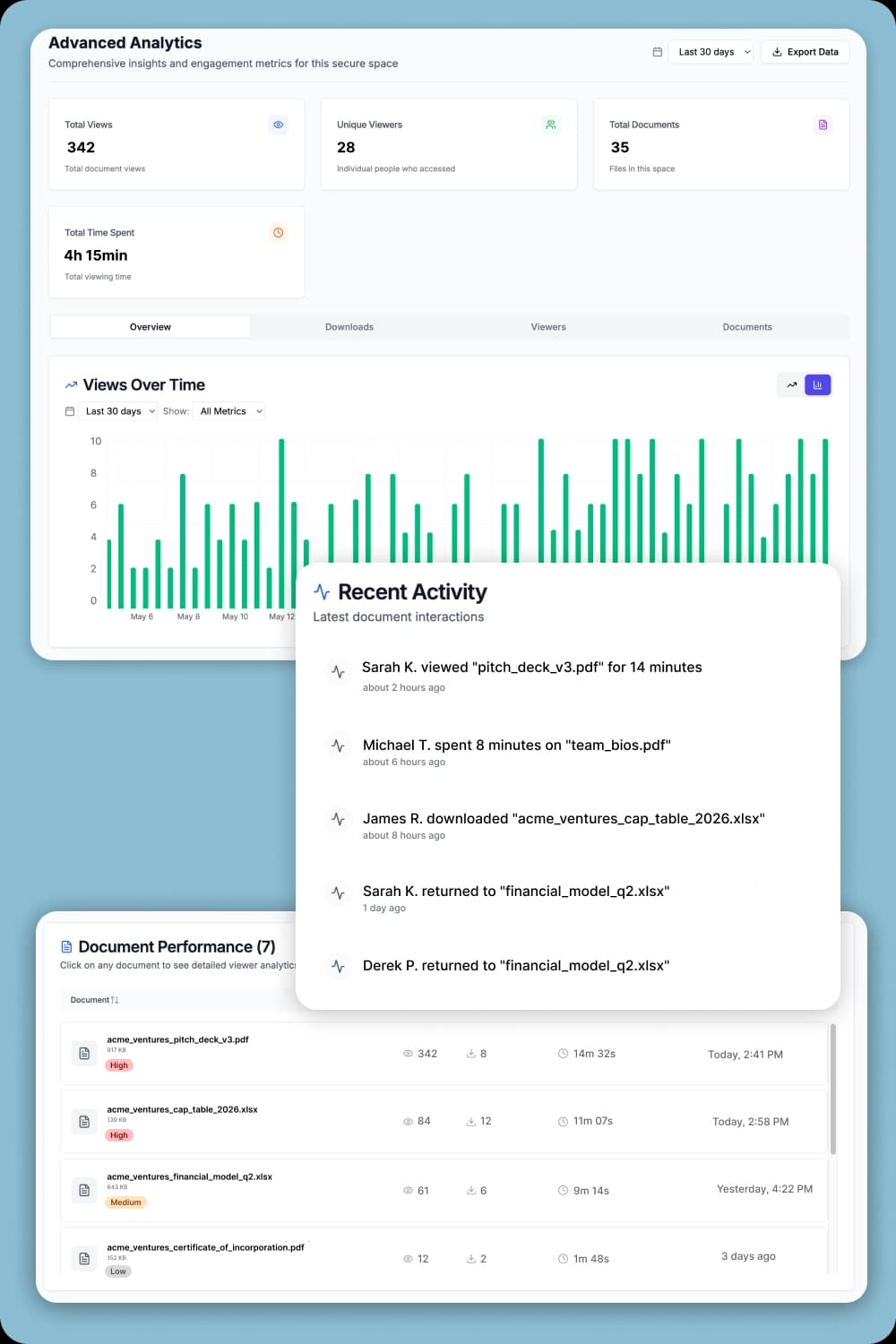
The solution to closing this institutional funding gap is embedding AI-powered data room tooling directly into community programs from the very beginning. By providing a CDFI startup program with tools like DealVue, program operators can definitively ensure that every founder is building their company on a solid, investable foundation. A modern data room is no longer just a static, passive file repository; it is an active, intelligent workspace that guides founders step-by-step through the diligence preparation process.
Automating Diligence with Clara AI
DealVue's Clara AI—a powerful 7-agent analysis engine—can actively review a founder's data room, flag missing documents, and provide actionable feedback, essentially acting as a virtual diligence team before a real VC ever sees the files. Historically, founders had to hire expensive startup lawyers or fractional CFOs at $500 an hour to audit their data rooms and tell them what was missing. This created a massive, insurmountable barrier to entry for founders operating outside of well-funded ecosystems who were bootstrapping their initial growth.
With Clara AI, that elite legal and financial expertise is democratized. The AI actively scans the uploaded documents, categorizes them according to venture capital standards, and generates a real-time compliance report. If a founder uploads their Articles of Incorporation but forgets their Bylaws, Clara AI flags the omission. If an employment contract is missing a standard IP assignment clause—a major red flag for investors—Clara AI highlights the exact risk and suggests a remedy. It can even detect complex discrepancies; for example, if the cap table states there are 10,000,000 shares issued, but the charter only authorizes 5,000,000, Clara catches the error instantly.
This proactive intelligence allows founders to iteratively improve their institutional readiness without incurring thousands of dollars in consulting fees. When a rural or underrepresented founder approaches a VC with a fully populated, intelligently organized DealVue data room, they immediately signal that they are a sophisticated, institutional-grade startup. This professional presentation directly translates into higher funding success rates and better valuations.
The Power of the Deal Readiness Score
One of the most powerful tools available to both founders and CDFI program managers within the platform is the Deal Readiness Score. This score provides a quantitative, objective measure of exactly how prepared a startup is for institutional diligence. Instead of subjective, vague advice like "you need to get your legal house in order," founders are given a clear score out of 100, backed by a comprehensive, prioritized checklist of actionable tasks.
For founders, the Deal Readiness Score essentially gamifies the preparation process. It provides a clear, step-by-step roadmap of what documents need to be created, signed, and uploaded before they start taking investor meetings, reducing anxiety and uncertainty. For program managers at CDFIs and accelerators, this score provides unprecedented, real-time visibility into the health and maturity of their entire cohort. Instead of guessing which startups are ready to be introduced to their investor network, program managers can look at their administrative dashboard, filter for companies with a Deal Readiness Score above 85, and make warm introductions to top-tier VCs with absolute confidence that the founder will represent the program exceptionally well.
Deploying Co-Branded DealVue Hubs
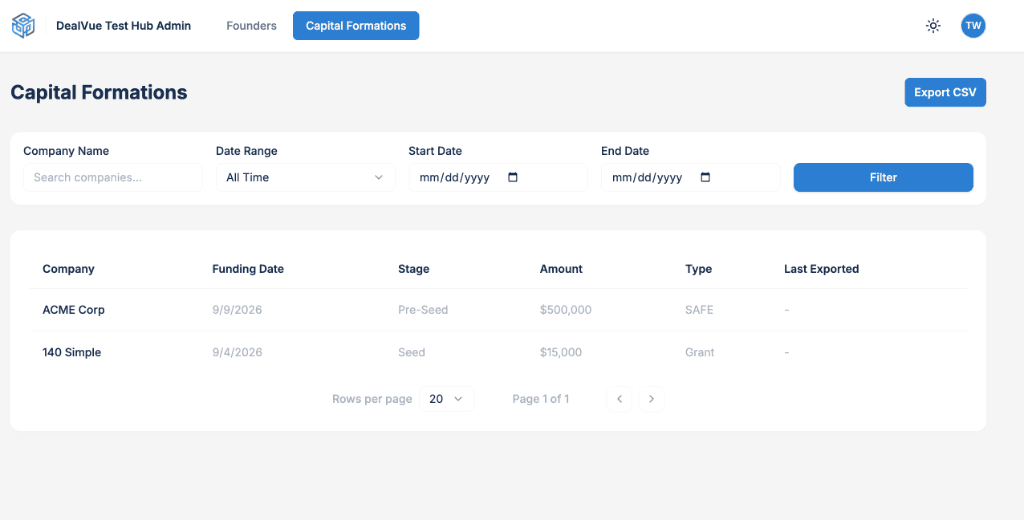
To facilitate this ecosystem-wide upgrade, DealVue offers co-branded Hub deployments specifically designed for state programs, CDFIs, and large accelerator networks. A DealVue Hub is a centralized management portal where the CDFI acts as the master administrator. From this Hub, program directors can instantly provision hundreds of premium data rooms for their cohort companies with a single click.
This white-labeled approach allows the economic development program to maintain its brand equity and trust with the founders, while secretly powering the backend with DealVue's venture-grade technology. Founders log into a portal that looks and feels like their local program, but they receive all the benefits of Clara AI and the Deal Readiness Score. Furthermore, the Hub provides macro-level analytics to the program directors. If the data shows that 80% of the cohort is struggling with financial projections, the program can dynamically adjust its curriculum to host a targeted workshop on financial modeling, shifting from generic education to precise, high-impact interventions.
A Proven Model: Amplify Louisville
This isn't just theory; it's a proven model. Consider Amplify Louisville (navigator.amplifystartups.com), a state-backed startup GPS supported by the Kentucky Cabinet for Economic Development. As DealVue's first hub partner, Amplify Louisville has seamlessly integrated this data room infrastructure directly into their platform, creating a powerful engine for local economic growth.
The Amplify Louisville Success Story
Amplify Louisville's mandate is to support entrepreneurs across the region, providing them with the resources, mentorship, and connections necessary to scale and create high-paying technology jobs in Kentucky. However, their leadership recognized early on that sending founders into investor meetings without the proper backend infrastructure was a disservice to both the founder and the investor. By partnering with DealVue, Amplify Louisville was able to deploy a co-branded DealVue Hub, providing every single startup in their ecosystem with a premium, AI-powered data room from the exact moment they joined the program.
The results speak for themselves. Amplify Louisville has successfully guided over 320 startups across Kentucky, helping them secure over $67M in venture capital deployed directly into the local economy. By giving founders a DealVue data room at the idea stage, Amplify Louisville ensures that their founders are structurally prepared for diligence long before they start pitching. This state-backed accelerator model demonstrates how equipping non-traditional ecosystems with top-tier infrastructure creates a reliable, highly fundable founder pipeline that attracts coastal capital to regional hubs.
Measuring the ROI for CDFIs and State Programs
For state economic development programs and CDFIs, the return on investment (ROI) from deploying a DealVue Hub is measured in ecosystem growth, capital attraction, and administrative efficiency. These programs are fundamentally judged by their impact metrics: jobs created, follow-on funding secured, and local wealth generated. Venture capital acts as a massive force multiplier for these mandates. When a local startup secures $2M in seed funding, that capital is deployed locally in the form of payroll, office space, and services, driving a localized economic boom.
By drastically reducing the friction in the due diligence process and ensuring founders are thoroughly prepared, programs can materially increase the close rate of their startups. This directly boosts their core KPIs and makes it easier for the CDFI to justify its own funding from federal grants, state taxes, or philanthropic donors. The ability to point to a dashboard and say, "Our cohort's average Deal Readiness Score increased by 40% over the last six months, leading to a 3x increase in venture funding," is incredibly powerful for stakeholder reporting.
Ultimately, building a fundable founder pipeline is about removing the invisible structural barriers that keep great companies from getting funded. Talent is distributed equally, but infrastructure is not. By embedding AI-powered data room infrastructure into the core of their programs, CDFIs and state-backed accelerators can definitively bridge the gap between raw potential and institutional capital, ensuring that the next generation of great companies can secure the funding they deserve, regardless of their zip code, background, or network.
Written by
Tim Wolter
Founder & CEO of DealVue · SafetyVue Founder · Peachscore Alum · EIR at Amplify Louisville · Author of The Last Year
Empower Your Cohort with Venture-Grade Diligence Infrastructure
Equip your founders with institutional data rooms, real-time readiness scoring, and co-branded investor portals.