
Most founders go into their first investor meetings vastly underprepared. They have a slick pitch deck, and maybe a basic top-line financial model, but when the VC leans in and asks for their comprehensive due diligence materials, the chaotic scramble begins.
Fundraising is a high-stakes performance, and the data room is your critical backstage setup. If the backstage is a mess—props missing, actors disorganized, scripts unwritten—the performance will inevitably suffer, no matter how good the lead actor is on stage. The Deal Readiness Score fundamentally changes how founders prepare for this crucial test, shifting the paradigm from guesswork to rigorous, quantified preparation.
The Problem with Gut-Feel Fundraising Readiness
For decades, founders have relied on a dangerous "gut feel" to determine if they are truly ready to raise institutional capital. You finish designing the pitch deck, run the high-level numbers, and think to yourself, "I'm ready." Then you get to the first serious diligence meeting and the partner calmly asks for your CAC payback cohort analysis, your IP assignment agreements for early contractors, and a clean, formula-driven cap table with a fully modeled unallocated option pool.
Founders usually learn what actually belongs in a data room the hard way: by being asked for a critical document they do not have. This immediately delays the deal, signals a profound lack of operational maturity to the investor, and drastically reduces the chances of receiving a term sheet. Every single day that passes between an investor asking for a document and you finally providing it is a day that deal momentum dies. In fundraising, time kills all deals. When you say, "I'll get that to you next week," you are explicitly telling the investor that you do not have a firm grip on the operational mechanics of your own business.
Quantified readiness beats gut-feel every single time. You need to know objectively if you are investor ready before you ever take that first meeting. You need to anticipate their requests before they even voice them. That requires a rigorous, objective standard to measure your materials against, rather than relying on outdated advice from a blog post written a decade ago. The modern fundraising landscape is hyper-competitive, and institutional VCs are constantly looking for any excuse to pass. Do not give them one on a silver platter simply because you forgot to upload your Certificate of Good Standing or a key employment agreement.
What the Deal Readiness Score Actually Measures
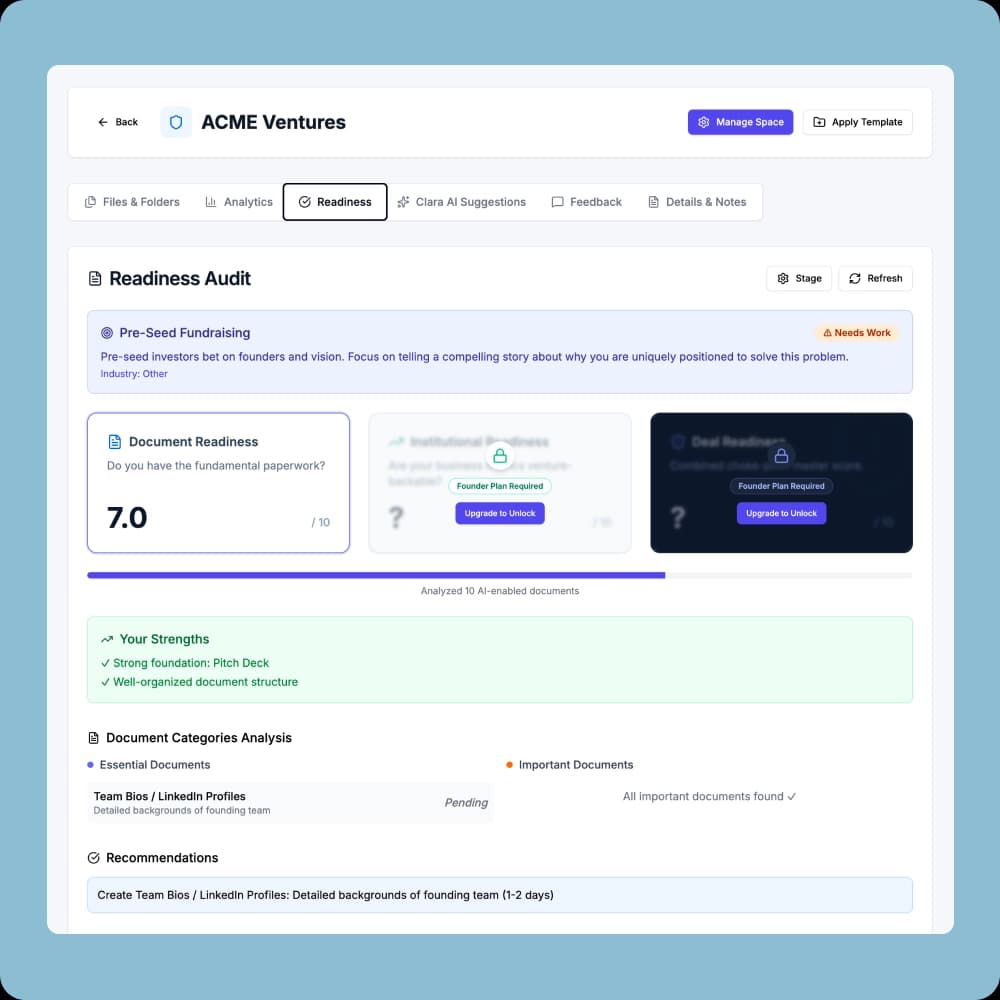
The Deal Readiness Score is a quantitative, objective measure of how prepared a startup is for institutional due diligence. It rigorously evaluates your data room contents against what VCs actually expect for your specific stage of growth (from Pre-seed through Series B). It completely removes the guesswork and replaces it with a rigorous, data-backed assessment.
Instead of a simple, unweighted flat checklist where every document is treated equally, the DealVue Deal Readiness Score uses a weighted 0-10 scale based on the proprietary 60/30/10 framework. This framework was painstakingly developed after analyzing thousands of successful venture deals and interviewing hundreds of active, check-writing partners at top-tier firms.
- 60% - Must-Haves (The Deal Breakers): Pitch deck, comprehensive financial model, clean cap table, and foundational legal incorporation documents. If you miss these, you fail the diligence check immediately. VCs view the absence of these documents as a fundamental failure of leadership. If a founder cannot produce a cap table, how can they realistically manage a $5M seed round?
- 30% - Should-Haves (The Strong Signals): Customer case studies, detailed product roadmaps, org charts, and GTM strategy breakdowns. These separate the truly prepared founders from the amateurs. They show that you are not just building a cool product, but building a durable company. They demonstrate that you intimately understand your sales motion, your organizational bottlenecks, and your long-term product vision.
- 10% - Nice-to-Haves (The Momentum Builders): Press clippings, letters of intent (LOIs), and notable advisor agreements that push a hesitant investor toward a "yes." These are the documents that create intense FOMO (Fear Of Missing Out) and validate the narrative you sold in the pitch meeting. They prove that credible third parties—customers, journalists, industry experts—believe in what you are doing.
How Clara AI Calculates Your Score in Minutes
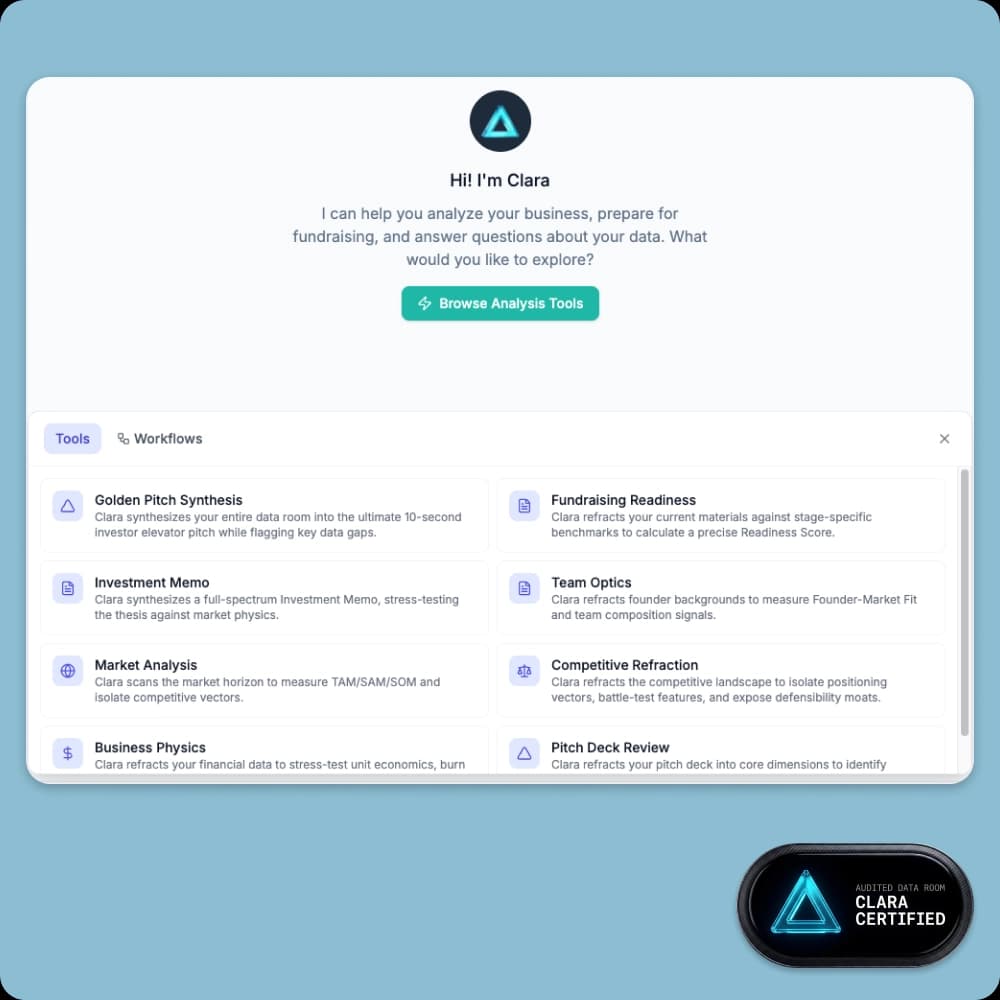
Evaluating a data room manually takes hours of tedious cross-referencing and deep domain expertise. DealVue automates this entire process using Clara AI. Clara is not just a simple keyword scanner; it is a sophisticated ensemble of 7 specialized AI agents explicitly designed to mimic the diligence process of a seasoned, cynical venture capital associate.
The 7 Agents of Clara AI
When you upload your files to the Secure Space, Clara deploys its 7 agents concurrently to analyze your materials from multiple rigorous perspectives:
1. The Financial Auditor: Checks your Excel model for structural integrity. Are there hardcoded revenue figures where there should be formulas? Does the model project out 3-5 years? Does it account for headcount scaling?
2. The Legal Eagle: Scans for missing IP assignments, ensures your incorporation documents are up to date, and flags highly unusual terms in advisor agreements.
3. The Cap Table Analyst: Verifies that the cap table mathematics sum correctly to 100%, checks for an appropriate option pool size relative to the round, and looks for dead equity from departed founders.
4. The Go-To-Market Specialist: Reviews your sales pipeline data, customer contracts, and CAC/LTV calculations for logical consistency and market realism.
5. The Narrative Matcher: Cross-references the bold claims in your pitch deck against the actual, sober data in your financials and legal documents to ensure absolute consistency.
6. The Structure Organizer: Evaluates your folder hierarchy, file naming conventions, and version control to ensure the data room is effortlessly navigable.
7. The Executive Synthesizer: Aggregates the findings from the other six agents, applies the 60/30/10 weighting framework, and instantly generates your overall Deal Readiness Score and an actionable, prioritized feedback report.
Understanding the Score Ranges in Practice
What does the final number actually mean for your fundraising timeline? The score is not arbitrary; it directly correlates to your probability of successfully closing a round. Here is the detailed breakdown:
Score Tier | Preparation Level | Market Impact & Outcome |
|---|---|---|
| 0 – 3: Not Ready | Missing core must-haves | High risk of immediate pass and burning introductions. |
| 4 – 6: Angel Ready | Basic files, unmodeled cap table | Sufficient for informal angels; institutional VCs will stall. |
| 7 – 8: Investor-Ready | Complete must-haves & should-haves | Confidently shareable with Series A partners; clean diligence. |
| 9 – 10: Institutional-Grade | Flawless diligence setup | Accelerated term sheets, zero diligence friction, maximum leverage. |
0–3: Not Ready for Investors
You are missing fundamental, essential documents. You likely only have a draft pitch deck and a high-level revenue sheet. Sharing a data room with this score will result in immediate, catastrophic rejection. Stop pitching and start actively building your diligence foundation. Attempting to raise with a score in this range will actively damage your reputation in the market. VCs talk to each other. If you burn a warm introduction by showing up completely unprepared, that partner will warn their peers. At this stage, your focus must be 100% on internal organization.
4–6: Fundable With Work (Angel Ready, VC Unready)
You have the basics, but institutional VCs will tear your room apart during their review. You might have a cap table, but it's a static PDF instead of a dynamic spreadsheet. You might have financials, but they lack clear assumptions and driver-based forecasting. You can potentially raise from friends, family, and lenient angel investors who invest based purely on narrative and personal conviction, but institutional funds will demand substantially more. A score of 5 means you are surviving, but you are absolutely not ready for prime time.
7–8: Investor-Ready
You have hit all the Must-Haves and most of the Should-Haves. Your room is clean, organized, professionally named, and secure. You can confidently share your VuePort link with Series A partners knowing you won't embarrass yourself. When a partner asks a tough diligence question on a call, you can point them directly to the corresponding folder in your data room. A score in this range signals that you respect the investor's time and take the fiduciary responsibilities of being a CEO extremely seriously.
9–10: Institutional-Grade
Flawless execution. Not only do you have every required document, but you have all the Nice-to-Haves. Your data room anticipates investor questions before they are even asked. You are running a highly competitive, ruthlessly professional fundraising process. Startups with scores in this range often command significantly higher valuations and close rounds faster because they completely eliminate diligence friction. The investor can move straight from excitement to a term sheet without being bogged down in administrative delays.
A Tale of Two Founders: Score 5 vs. Score 8
Let's walk through a real-world example to illustrate the difference. Founder A has a score of 5. Their data room consists of a well-designed pitch deck, a one-page historical P&L, and a PDF cap table. They send this to an interested VC. The VC immediately replies, asking for a forward-looking financial model and IP assignments. Founder A spends a highly stressful week trying to build the model from scratch and scrambling to get old contractors to sign IP documents. By the time they finally send the files, the VC has cooled off, found another deal, and passed on Founder A.
The Score 8 Experience
Founder B has a score of 8. Their data room includes the deck, a driver-based Excel model, a clean equity spreadsheet, all incorporation documents, and placeholder memos explaining the absence of non-critical documents. They send the link. The VC logs in, finds exactly what they need in the neatly numbered folders within minutes, verifies the unit economics, and brings Founder B in for a partner meeting the following Monday. The difference between a 5 and an 8 is often the difference between a stalled, failed process and a funded, successful company.
Using the Score Iteratively: Build, Score, Fix
The Deal Readiness Score isn't just a final grade; it's a highly actionable, iterative roadmap. You do not need to wait until your data room is visually perfect to start scoring it.
The Feedback Loop
The optimal workflow is simple: Build → Score → Fix → Score again. Upload exactly what you have right now. If you score a 5, Clara AI doesn't just give you a bad grade; it tells you exactly what to fix first to maximize your score increase, preventing you from wasting time on low-impact tasks. For instance, if Clara flags missing IP assignments (a massive Must-Have penalty), you fix that critical legal issue before tweaking the font on your pitch deck. By iterating rapidly on Clara's feedback, you can move from a 4 to an 8 in a matter of days.
The Psychology of Scoring: Overcoming Imposter Syndrome
Founders often delay fundraising because they suffer from imposter syndrome regarding their business maturity. They fear the rigorous scrutiny of institutional VCs. The Deal Readiness Score acts as a powerful psychological mechanism to overcome this inertia.
When you rely on gut feel, the anxiety of "am I ready?" never fully dissipates. When you rely on a quantified score, the anxiety is replaced by a clear, manageable checklist. A score of 8 doesn't just tell the investor that you are ready; it tells you that you are ready. It provides the empirical permission needed to step confidently into high-stakes negotiations, knowing that your foundation is rock solid.
Ecosystem Tracking: Accelerators and Programs
The Deal Readiness Score isn't just for individual founders. Top startup accelerators, incubators, and university ecosystem programs use it for cohort-wide tracking at scale.
Prioritizing Mentor Time
Program directors face a massive operational challenge: how do they know which of their 50 cohort startups are actually ready for Demo Day? Relying on founder self-reporting is dangerous and often inaccurate. With DealVue, directors can look at a unified, real-time dashboard and immediately see that Company A has a score of 9.2 (ready for Demo Day introductions) while Company B is stuck at 4.1 (needs urgent financial modeling help from a mentor). It standardizes the definition of "readiness" across the entire venture ecosystem, allowing programs to deploy their highly valuable mentor resources exactly where they are needed most.
Don't leave your fundraising to chance. Know your objective score before the VC asks for your link, and take absolute control of your diligence process. With DealVue, you can walk into any investor meeting armed with the deep confidence that your backstage is as flawless as your pitch performance.
Audit Your Deal Readiness in 5 Minutes
Upload your pitch deck, financials, and legal docs to Clara AI and discover your baseline Deal Readiness Score before meeting institutional investors.