
For years, DocSend has been the default choice for sharing pitch decks. It tracks when investors open your PDF and how long they look at each slide. But in today's fundraising environment, basic document tracking isn't enough.
The fundraising landscape has fundamentally shifted over the past decade. Previously, raising a seed round involved sharing a PDF over email, waiting for a reply, and maybe hoping that the investor opened it at all. DocSend entered the market as a revelation: finally, founders could know exactly who opened their deck and which slide they spent the most time on. But the novelty of link tracking has worn off. Institutional investors are looking at hundreds of deals per week, and a read receipt doesn't tell you how to improve your pitch, nor does it help the investor champion your deal to their partnership.
Founders are now realizing that a passive file tracker is just that—passive. It's a repository for your files, not a strategic asset. You need a platform that actively helps you identify weaknesses in your materials before an investor ever sees them, while empowering you with the tools to close the deal. If you're a founder asking yourself what the best alternative to DocSend is for your next round, you're not just looking for a different UI to upload a PDF. You are looking for a deal ecosystem that brings intelligence, AI-driven feedback, and structured workflows to your fundraising efforts.
Fundraising is an enterprise sales process, but founders often treat it like a top-of-funnel marketing campaign. They blast links hoping for a high open rate. But closing a $5M Series A doesn't happen because of a high open rate; it happens because you pass a rigorous, structured diligence process. That is the fundamental gap that legacy tracking tools ignore.
Why DocSend is Fine for Tracking (But Fails at Deal Prep)
DocSend is a utility. It hosts a file and tracks views. But it doesn't help you figure out what to share, or whether your documents are actually ready for institutional scrutiny.
The Limits of the Link Tracker
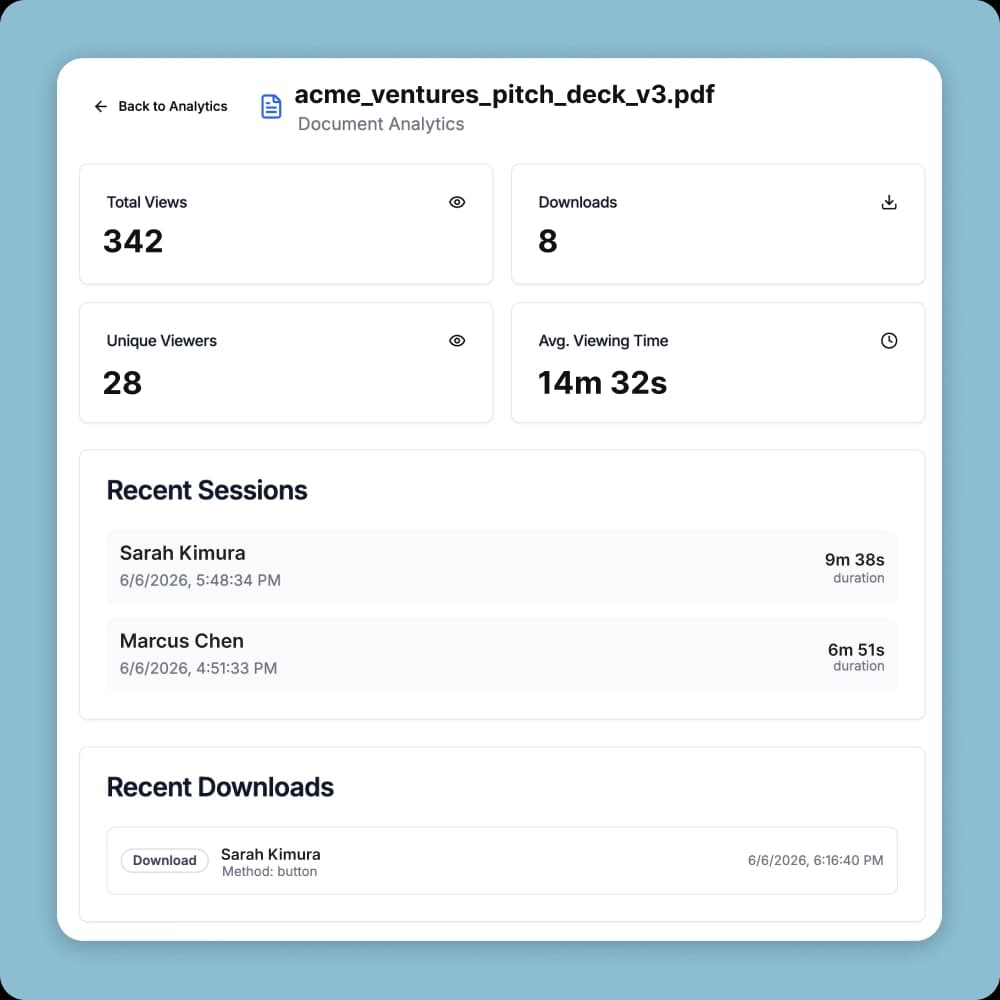
When you use a basic link tracker, you are essentially flying blind until the post-mortem. Sure, you might see that a venture capital partner spent exactly 43 seconds on your "Go-To-Market" slide and then immediately bounced. That is an interesting data point, but it lacks actionable context. Why did they bounce? Was your customer acquisition cost (CAC) math flawed? Did you fail to demonstrate a scalable distribution channel? Did you omit key competitor analysis? A static link tracker cannot answer these questions.
DocSend tells you the what, but completely ignores the why. In high-stakes institutional fundraising, the "why" is everything. For many founders, discovering that their deck has a fatal flaw only happens after burning through warm introductions to top-tier funds. You don't want to learn that your financial model is missing a critical driver or that your cap table is overly complicated only after a Tier-1 VC passes on your deal.
- It doesn't tell you if your financial model is missing key projections, like cohort retention, unit economics breakdowns, or cash flow burn rates.
- It doesn't warn you if your cap table lacks option pool details, SAFE note conversions, or has unvested founder shares that will raise immediate red flags during legal diligence.
- It doesn't generate an investor memo to help the VC champion your deal internally during their Monday partner meetings.
- It fails to provide an ecosystem-level understanding of what standard institutional diligence actually looks like in today's highly competitive market.
Real-World Scenario: The Missed Seed Round
Consider a typical SaaS startup raising a $2M Seed round. The founder sets up a standard DocSend link, uploads a beautifully designed 12-slide PDF, and emails it to 50 targeted investors. The analytics dashboard shows fantastic open rates. Investors are looking at the deck, spending solid time on the traction slide, and then... crickets. No meetings are booked, and the polite passes start rolling in.
The founder assumes the macro environment is just tough right now. In reality, the founder forgot to include a data room folder with historical P&L statements, a breakdown of their current cap table, and a clear product roadmap. Institutional investors, already stretched for time, saw a shiny deck but immediately realized the deal wasn't mature enough for serious diligence. Because DocSend is purely reactive software, it never warned the founder that their data room was hopelessly incomplete. They burned their best leads because they used a file viewer instead of a proactive deal preparation platform.
DealVue: The Upgrade for Serious Founders
DealVue isn't just a tracking link; it's an Intelligent Deal Room designed specifically for fundraising. DealVue is the best DocSend alternative because it acts as your AI co-pilot throughout the entire fundraising process, combining the security and tracking you expect with proactive intelligence you actually need.
More importantly, DealVue isn't just a point-solution. It acts as a Hub infrastructure product for startup ecosystems, connecting founders, investors, and advisors into a streamlined deal flow pipeline. It doesn't just host your files; it analyzes them, grades them, and helps you optimize them.
Feature / Capability | DocSend Passive Link Tracker | DealVue Intelligent Deal Ecosystem |
|---|---|---|
| Document Tracking & Per-Slide Analytics | Yes | Yes |
| Dynamic Watermarking & NDA Gating | Yes | Yes |
| 7-Agent AI Diligence & Red Flag Audit | No | Yes (Clara AI) |
| Deal Readiness Score (0-10) | No | Yes (Tiered Audit) |
| Built-in Cap Table & SAFE Modeling | No | Yes (Scenario Engine) |
| Automated VC Partner Memo Generation | No | Yes (Instant Memos) |
| Startup Ecosystem & Accelerator Hub | No | Yes (Cohort Portals) |
Clara AI: Your 7-Agent Analysis Co-Pilot
The secret weapon within DealVue is Clara AI. Clara isn't just a generic language model slapped onto a dashboard; it is a sophisticated, 7-agent analysis engine that reads your data room exactly like an institutional venture capitalist would. When you upload your pitch deck, financial model, and legal docs to DealVue, Clara deploys specialized agents to review different aspects of your business.
These agents act as your personal due diligence team:
- The Financial Auditor: Dives into your Excel models, checking if your revenue projections mathematically align with your stated hiring plan and CAC assumptions.
- The Market Analyst: Evaluates your TAM/SAM/SOM breakdown, cross-referencing your claims against logical frameworks and market realities.
- The Legal Reviewer: Scans your formation documents, IP assignments, and employment agreements for missing signatures or non-standard clauses.
- The Cap Table Strategist: Looks at your equity distribution to ensure you have a healthy, standard capitalization structure that won't deter future investors.
- The Go-To-Market Specialist: Analyzes your distribution strategy for scalability and logical consistency.
- The Competitor Analyst: Ensures you have adequately addressed the competitive landscape without relying on generic, unhelpful matrix charts.
- The Product Architect: Reviews any technical documentation or product roadmaps to ensure your product vision matches your engineering resourcing.
Clara identifies missing documents, highlights potential red flags that will inevitably come up in partner meetings, and gives you actionable advice on how to fix them before you send out a single link. It's like having a Tier-1 VC associate reviewing your materials and giving you honest, private feedback before the real test begins.
The Deal Readiness Score
How do you know if you are actually ready to raise? DealVue replaces guesswork with a definitive Deal Readiness Score, grading your entire data room on a scale from 0 to 10. This isn't an arbitrary number; it's a rigorously weighted evaluation based on what institutional investors actually demand during diligence.
The score is broken down into three critical tiers to help you prioritize your prep:
- 60% Must-Haves: These are the absolute non-negotiable items that will kill a deal instantly if missing or poorly executed. This includes a clear, well-structured cap table, detailed historical financials, a comprehensive forward-looking financial model, and foundational legal formation documents. If you fail here, Clara will flag it immediately and your score will plummet.
- 30% Should-Haves: These elements separate good deals from great ones. Think customer reference lists, detailed technical architecture diagrams, market research reports, and clear, granular use-of-funds breakdowns. Investors might ask for these later, but having them upfront shows extreme preparation.
- 10% Nice-to-Haves: These are the finishing touches that show extreme professionalism and polish, such as founder introduction videos, team bios, press clippings, and case studies.
By aiming for a 9.0+ Deal Readiness Score, you ensure that you are bringing an institutional-grade data room to the table, removing friction for the investor and accelerating your path to a term sheet.
VuePort Secure Sharing and Next-Gen Engagement Analytics
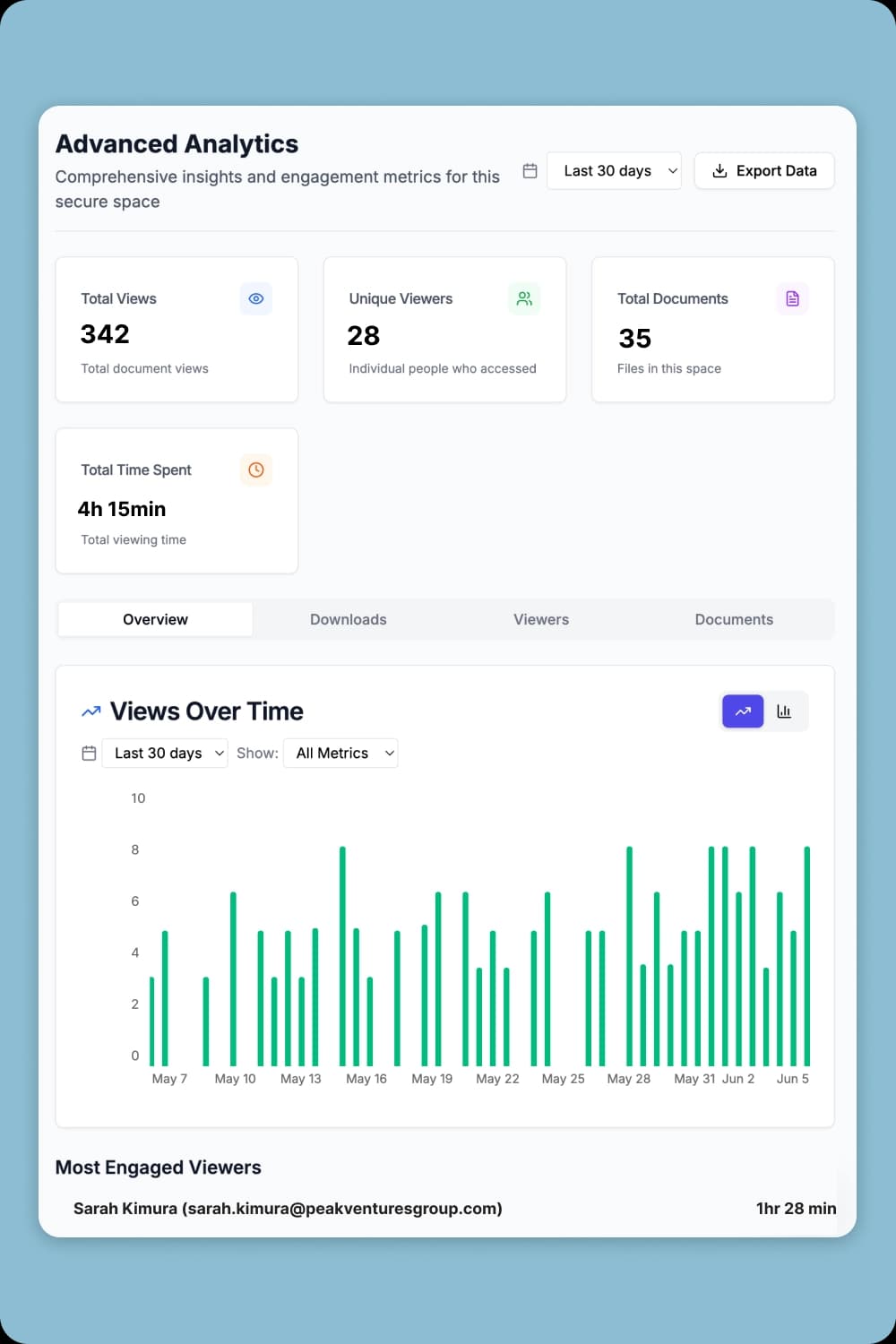
With DealVue, you get the same Secure Sharing (VuePort links) and Engagement Analytics (page-by-page tracking) you expect, plus much more. VuePort isn't just about gating access behind an email capture form. It's about granular, professional control. You can set strict expiration dates, dynamically watermark documents with the viewer's email to prevent leaks, restrict downloading entirely, and create highly personalized deal rooms tailored for specific funds.
When an investor interacts with your VuePort, the Engagement Analytics go beyond simple time-on-page metrics. DealVue synthesizes this data into Intent Signals, showing you the overall momentum of the deal. You can track which partners have been invited into the room, whether the deal is being forwarded to analysts or other partners, how often the team returns, and which specific files (like the financial model or the cap table) are being heavily scrutinized. If an investor spends 20 minutes in your financial model folder, DealVue lets you know that it's time to follow up with a highly targeted message.
Cap Table Modeling and Deal Scenarios
One of the most complex, anxiety-inducing parts of fundraising is understanding dilution and equity mechanics. DealVue includes built-in Cap Table Modeling that allows you to run multiple deal scenarios instantly, right inside the platform. Want to see exactly how a $3M raise at a $15M pre-money valuation with a 10% option pool expansion affects your founder equity? What if the investors use SAFEs versus Convertible Notes? DealVue models it in seconds.
This feature ensures that you aren't caught off guard during intense negotiations. Your data room always reflects accurate, mathematically sound equity structures. It bridges the critical gap between sharing a static, often-broken Excel spreadsheet and actively managing your company's ownership with confidence.
Automated Investor Memo Generation
Perhaps the most powerful, game-changing feature of DealVue is the Investor Memo Generator. Ask any venture capitalist, and they will tell you the truth: getting a deal done requires an internal champion to write a comprehensive investment memo for the partnership. This process can take weeks of tedious back-and-forth Q&A, stalling momentum and risking the deal falling apart.
DealVue accelerates this fundamentally by having Clara automatically draft a highly detailed, institutional-grade investor memo based directly on the contents of your data room. It synthesizes your market, product, team, traction, and financials into a cohesive, persuasive narrative. You can read it yourself to see exactly how an investor will perceive your business. More importantly, you can provide it directly to a VC associate in your data room, giving them a massive head start on championing your deal internally. This feature alone can shave weeks off your fundraising timeline and increase your closing probability exponentially.
A Hub Infrastructure for the Startup Ecosystem
Beyond individual founders, DealVue is engineered as a core infrastructure product for the broader startup ecosystem. Accelerators, venture studios, incubators, and advisory firms use DealVue to standardize how their portfolio companies prepare for funding. Rather than relying on ad-hoc Google Drive folders and fragmented advice, these ecosystem players use DealVue to mandate a baseline level of quality.
When an accelerator adopts DealVue, they ensure every founder graduates with a structured data room, a verified Deal Readiness Score, and an AI-generated memo that translates their vision into investor-ready language. This standardized approach dramatically increases the portfolio's overall funding success rate and builds trust with downstream institutional investors who know that a DealVue room means the startup is genuinely prepared for diligence.
How to Migrate and Who Each Platform is Right For
Transitioning your workflow from a legacy tracker to an intelligent deal room is easier than you might think. But the most common question founders ask is: "Which platform is actually right for my current stage of growth?"
When to Use DocSend
DocSend still has its place in the ecosystem. If you are raising a very early $150k to $250k pre-seed round entirely from friends, family, and angel investors who are writing personal checks based solely on your vision, your character, and a prototype, DocSend is perfectly adequate. In these scenarios, deep, institutional diligence simply isn't happening. Angels are generally not running your financial model through extreme stress tests or requiring a massive data room with 40 distinct folders of legal minutiae. If you just need to blast a 10-slide PDF to 100 angels, see who opens it, and follow up, a basic tracker works fine.
When DealVue is Mandatory
However, the moment you transition to institutional capital—whether that's a professional Seed fund, a Series A, or beyond—DealVue becomes an absolute requirement. Institutional investors have strict fiduciary duties to their Limited Partners (LPs). They cannot, and will not, invest based on a PDF alone. They require exhaustive, meticulous diligence.
If you are pitching funds that lead rounds, take board seats, and write multi-million dollar checks, you need DealVue. The Clara AI analysis will save you from embarrassing unforced errors, the Deal Readiness Score will ensure you look like a seasoned professional who respects their time, and the automated Investor Memo will arm your internal champion with the ammunition they need to fight for your deal at the high-stakes Monday partner meeting.
Migrating Your Files: A Seamless Transition
Migrating from DocSend to DealVue is a seamless, pain-free process. Instead of just dropping files into a chaotic flat list, DealVue's structured data room templates guide you on exactly where to place your documents based on industry best practices. You can drag and drop your existing pitch deck, historical financials, and cap table directly into DealVue.
Within minutes, Clara AI will process the entire room, generate your baseline Deal Readiness Score, and give you immediate, actionable feedback on what you need to add, fix, or clarify before generating your VuePort sharing links. You upgrade from a static link to an active intelligence hub in less than an hour.
Make the Switch
If you are serious about raising from institutional investors, you need significantly more than just a read receipt telling you someone glanced at your PDF. You need an intelligent platform that prepares you for grueling diligence, anticipates tough investor questions, and actively helps you close the deal. When you use DealVue, you are no longer just sending a file; you are inviting investors into a comprehensive, highly professional deal ecosystem.
Stop guessing whether your data room is truly ready. Stop wondering why investors are dropping off after the first meeting without giving you honest feedback. Leverage the unprecedented power of Clara's 7-agent analysis, optimize your Deal Readiness Score to a 9.0+, and give your VC champion the automated Investor Memo they desperately need to get your deal across the finish line.
The fundraising market is too competitive to rely on outdated tools. Upgrade to DealVue, take control of your narrative, and treat your fundraising process with the institutional rigor it deserves. The difference between a funded startup and a failed raise often comes down to preparation, and DealVue ensures you are always prepared.
Upgrade Beyond Static Link Tracking
Prepare institutional-grade data rooms with Clara AI diligence, cap table modeling, and auto-generated investment memos.