
Ask any pre-seed or Series A founder to open their monthly credit card statement, and you will discover a quiet financial epidemic: the unbundled fundraising software tax.
To execute a standard venture capital raise, founders have historically been advised to assemble a fragile patchwork of single-purpose point solutions. You pay Dropbox-owned DocSend $150 to $250 per month just to track who looks at your pitch deck. You pay Carta $2,000 to $3,500 every year to record a handful of SAFEs and stock option grants. You pay Visible.vc another $500 to $1,000 annually to email monthly updates to your angel syndicate. And you still end up using Google Drive or Notion as an ad-hoc virtual data room because none of those platforms natively integrate with one another.
All told, the average early-stage startup burns between $4,000 and $6,500 per year on fragmented investor software before even taking a dollar in revenue.
In today's venture environment—where capital discipline is celebrated and bloated overhead is scrutinized—founders are rejecting this unbundled bloat. This in-depth guide examines why the traditional fundraising stack is broken, how tool fragmentation sabotages deal velocity, and how modern platforms like DealVue unify the entire workflow into a single operating system starting at $19 per month.
The Rise of the Fragmented Fundraising Toolchain
To understand how we reached this point of extreme software fragmentation, we must look at how venture tools evolved over the past fifteen years. Each major player emerged to solve a single, isolated symptom of the fundraising process:
- DocSend (Launched 2013): Emerged to fix a simple problem: founders had no idea whether investors were actually reading their email attachments. DocSend built page-by-page document tracking with link controls. It did this job well, but as Dropbox acquired it, the product largely stagnated into a static PDF viewer while prices climbed steadily.
- Carta (Launched 2012 as eShares): Digitized paper stock certificates and cap table ledgers. It revolutionized private equity administration, but over time pivoted toward enterprise private equity, secondaries, and fund administration—leaving early-stage startups paying enterprise pricing for basic SAFE tracking.
- Visible.vc (Launched 2014): Created structured investor update templates so founders could write quarterly update emails with KPI charts.
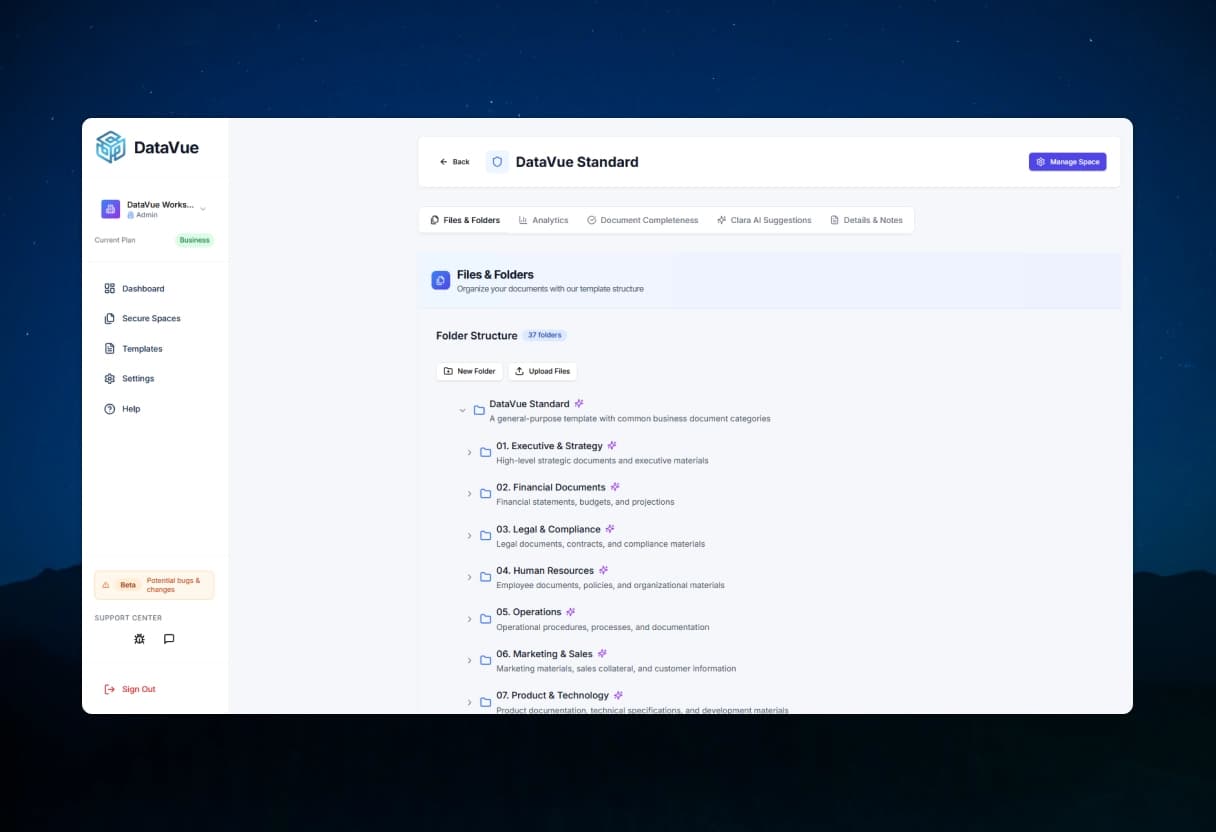
While each tool served a purpose in isolation, founders were left holding the bag. A founder raising a seed round had to upload their pitch deck to DocSend, manage their shares in Carta, write updates in Visible, and store their contracts in Google Drive.
The Hidden Costs of Software Fragmentation (Beyond the Dollar Amount)
While the monetary savings of replacing multiple subscriptions is obvious, the operational friction of a fragmented stack is far more damaging to a founder's fundraising momentum. Consider the three hidden taxes of running disconnected tools:
1. The Cognitive Load on Prospective Investors
Venture capital partners evaluate dozens of opportunities each week. When an investor gets excited about your business, deal momentum is everything. Every obstacle, extra login screen, or broken link saps that momentum.
In the traditional stack, the investor must navigate a maze of disparate interfaces:
- They review your deck via a DocSend URL with a passcode.
- They request your cap table, so you send them a shared Google Drive folder that requires Google account authentication.
- They ask about convertible note conversion mechanics, forcing you to send a raw spreadsheet or invite them to a secondary portal.
This disjointed experience signals organizational immaturity. Institutional investors subconsciously associate operational clutter with execution risk. Conversely, when a founder delivers a single, beautifully branded DealVue VuePort room—where the deck, financial models, diligence checklists, and interactive equity waterfalls exist under one unified umbrella—the signal of competence is unmistakable.
2. The Permission Leak Hazard
Managing access control across four separate cloud platforms is an administrative nightmare. Consider what happens when you pass on an angel investor, or when a diligence process with an aggressive competitor-backed corporate VC stalls:
- You disable the DocSend link, but you forgot to revoke access to the Google Drive folder containing your technical architecture.
- You revoke the Google Drive link, but an unredacted cap table spreadsheet was already downloaded and forwarded to their analyst team.
- You have no way of knowing which slides or contracts were forwarded, printed, or screenshotted.
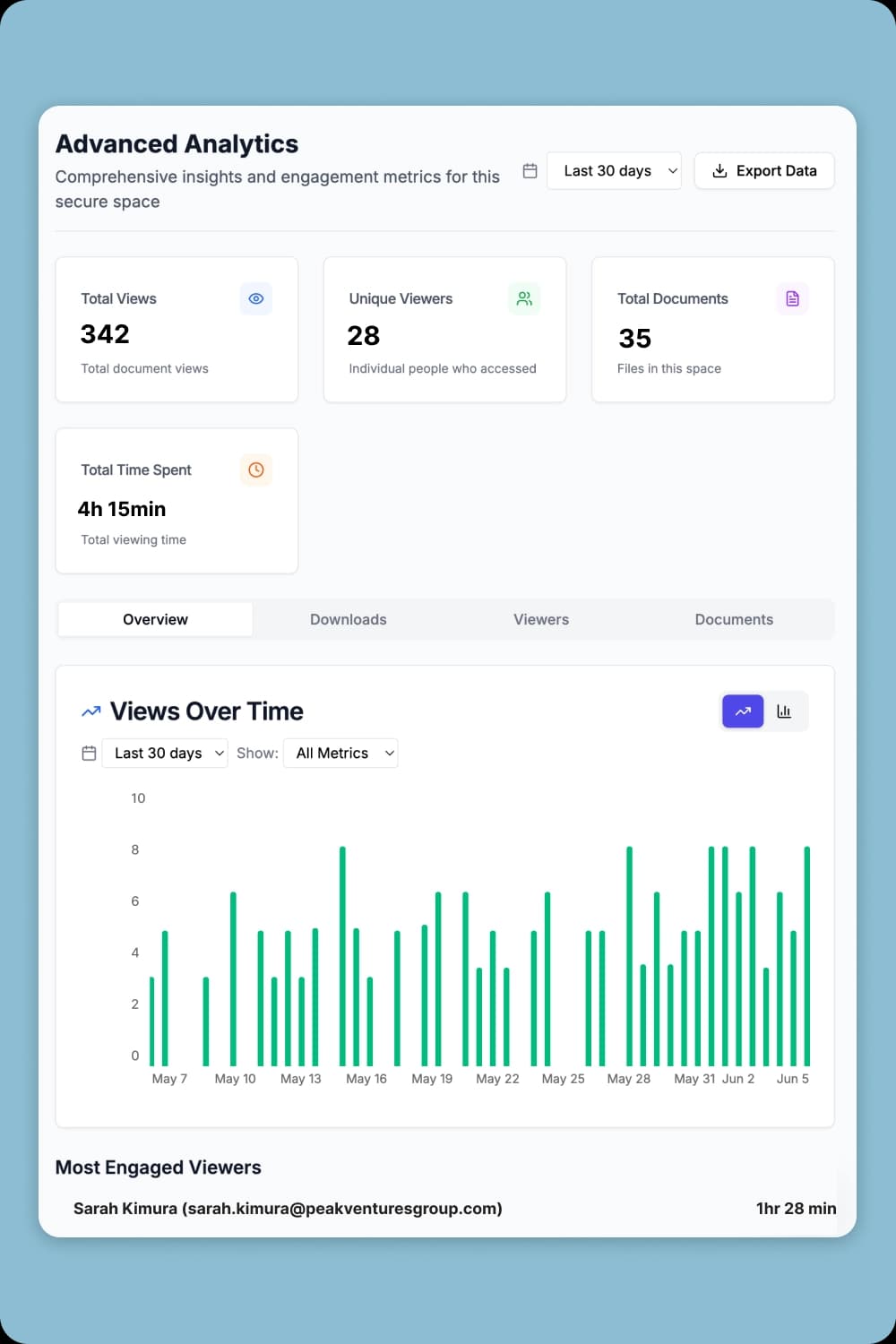
With DealVue, access control is governed by a global Kill Switch. With one click, a founder can revoke access across all documents, cap table summaries, and shared spaces instantly across edge servers worldwide. Recipient emails and IP addresses are dynamically watermarked across every viewer session, deterring leaks before they happen.
3. Data Desynchronization
During an active fundraise, your business metrics and capitalization structure evolve weekly. You issue a new SAFE to a strategic angel. You update your monthly ARR numbers. You tweak your financial model.
When your tools are siloed, maintaining parity between them requires tedious manual labor. If you update your cap table in Carta, you must remember to update the static PDF in your data room, re-calculate the dilution scenario in Excel, and update the headline metrics in your investor update tool. Discrepancies between your pitch deck metrics and your diligence room cap table are one of the most common red flags that kill institutional deals in partner meetings.
4. Multi-Vendor Attack Surface and Vendor Lock-in
Every additional SaaS vendor integrated into your company's operational flow introduces a new vector for data breach, credential compromise, and unexpected contractual escalation. When your founding team stores investor communications in DocSend, cap table ledgers in Carta, financial spreadsheets in Google Workspace, and monthly investor updates in Visible, your attack surface multiplies fourfold. A single compromised employee login or third-party OAuth token can expose your entire corporate foundation.
Furthermore, legacy point solutions rely on vendor lock-in to extract exorbitant renewal fees. When a vendor knows that migrating your historical cap table or diligence history requires weeks of manual transcription, they have zero hesitation in raising prices by 30% to 50% year-over-year. By consolidating your fundraising lifecycle into DealVue, your company benefits from a single, unified security perimeter guarded by zero-knowledge Application-Level Encryption (ALE), complete data portability, and no punitive pricing spikes.
The Mathematical Breakdown: Traditional Stack vs. DealVue
Let us look at the concrete financial comparison between the legacy point-solution stack and DealVue over a standard 12-month operating cycle:
Tool / Platform | Core Purpose | Legacy Cost (Annual) | DealVue Business |
|---|---|---|---|
| DocSend Advanced | Pitch deck tracking & links | $1,800 – $3,000 / yr | Included (Unlimited rooms) |
| Carta Core | Cap table & SAFE management | $2,000 – $3,500 / yr | Included (ALE Encrypted) |
| Visible.vc / Substack | Monthly investor updates & KPIs | $600 – $1,200 / yr | Included (Automated reporting) |
| Fractional CFO / Modeling | Exit waterfall simulations | $1,500+ ad-hoc | Included (Interactive simulator) |
| External Pitch Review | Diligence gap analysis | Manual advisor hours | Included (Clara 7-agent AI) |
| Total Annual Expenditure | Full fundraising stack | $4,400 to $7,700+ | $948 / year ($79/mo) |
The difference is stark: an immediate cash savings of $3,452 to $6,752 per year. For an early-stage company operating on a 15-month seed runway, eliminating $5,000+ in administrative overhead extends your survival window and frees up capital for growth experiments that actually move your valuation needle.
How Clara AI Transforms the Consolidated Stack
The true power of consolidating your fundraising infrastructure is not just lower bills—it is intelligence.
When your pitch deck, your cap table, your financial model, and your customer contracts live inside separate cloud repositories, artificial intelligence cannot help you. DocSend cannot analyze your cap table because it cannot see it. Carta cannot audit your pitch deck because it only tracks equity shares.
Because DealVue brings all core fundraising assets into a secure, Application-Level Encrypted workspace, our proprietary Clara AI operates across your entire deal corpus:
- The Diligence Gap Auditor: Clara analyzes your complete data room against Tier-1 institutional standards, calculating your quantitative Deal Readiness Score™ and surfacing missing disclosures before an investor ever flags them.
- Cross-Document Integrity Checks: If your pitch deck claims a $15M pre-money valuation cap on a SAFE, but your cap table ledger records an $18M cap, Clara flags the discrepancy immediately.
- Instant Investor Memo Generation: Clara synthesizes your pitch deck, market size slides, and financials into an institutional investment memo formatted specifically for venture capital partner meetings.
And most importantly for founders concerned with confidentiality, Clara operates under our strict Zero AI Model Training Guarantee. Your documents, patent filings, and proprietary numbers are processed in isolated, ephemeral memory—never stored, never leaked, and never used to train public or commercial foundation models.
Step-by-Step: Consolidating Your Stack in an Afternoon
Transitioning from the legacy multi-tool nightmare into DealVue is simple and requires zero engineering support:
Consolidating Your Stack in an Afternoon
Import Your Cap Table
Export your cap table CSV from Carta or Excel and drop it into DealVue. Our automated parser maps shareholders, SAFEs, and option pools in under 60 seconds with instant AES-256-GCM encryption.
Upload Pitch Deck & Diligence Folders
Upload your pitch presentation and financial model. Generate a secure VuePort sharing link with custom email watermarking and link expiration dates.
Run Your Baseline Deal Readiness Score™
Run Clara AI across your space. Review her red-team diligence audit, fix any missing documentation, and see your readiness score climb.
Cancel Redundant Subscriptions
Cancel DocSend, turn off auto-renew on Carta, and terminate your standalone email update software. Reinvest your $4,000+ in annual savings directly into product growth.
Conclusion: The Pragmatic Choice for Modern Founders
In the early days of SaaS, unbundling reigned supreme. Today, efficiency rules. As founders navigate an increasingly competitive funding environment, those who eliminate unnecessary software friction and consolidate their tools gain an immediate competitive advantage.
You don't need three separate logins, three separate monthly invoices, and disjointed security controls to raise a great round. You need an Intelligent Deal Room that keeps your data secure, your cap table accurate, and your investors engaged.
Ready to Consolidate Your Fundraising Stack?
Replace DocSend, Carta, and Visible with DealVue. Start on our free Launchpad plan or upgrade to Business for $79/mo.