
Every venture founder remembers the intoxicating feeling of receiving their first Series A term sheet. You see a bold headline valuation: "$20 Million Post-Money Valuation, $5 Million New Investment."
You quickly do the back-of-the-envelope math in your head. You own 60% of the common stock. At a $20M valuation, your personal equity stake is worth $12 million. If you sell the company in five years for $50 million, you assume you will walk away with $30 million.
Unfortunately, startup equity rarely works through simple multiplication. When institutional venture capitalists invest in a priced equity round, they do not purchase common stock—the shares held by founders and employees. They purchase Series A Preferred Stock.
Buried beneath the headline valuation on page three of the term sheet are the clauses that truly govern how proceeds are distributed in an acquisition: liquidation preference multiples, participation rights, seniority tiers, and compounding cumulative dividends.
Depending on how these clauses are structured, an acquisition that looks like a great financial success can result in common shareholders walking away with pennies—or nothing at all. This masterclass deconstructs the mathematical mechanics of venture capital term sheets, explains how exit waterfalls operate, and shows why founders must simulate liquidation scenarios before signing a term sheet.
The Transition: From Simple SAFEs to Preferred Stock Economics
During pre-seed and angel rounds, equity mechanics are relatively forgiving. Y Combinator Post-Money SAFEs (Simple Agreements for Future Equity) and convertible notes are designed to defer structural complexity. You agree on a valuation cap and a discount rate, receive the cash, and return to building product. There are no liquidation preferences, no board seats, and no dividend accruals.
However, when you raise a priced Series A or Series B round, the legal architecture fundamentally transforms. Preferred stock confers specific economic and governance rights designed to protect institutional downside risk.
The core purpose of preferred stock is simple: institutional investors get paid back their capital before common shareholders receive a single dollar. How much they get paid, and under what conditions they participate in remaining profits, is determined by three variables:
1. Liquidation Preference Multiples (1x vs. 2x vs. 3x)
The liquidation preference multiple defines how many times their original investment the preferred shareholder must receive before common stock participates in liquidation proceeds:
- 1x Preference (Standard Market Term): If a VC invests $5M, they are guaranteed to receive their $5M back first before common stock sees any proceeds. This is the standard in healthy venture environments.
- 1.5x to 2x Preference (Downside Protection / Hostile): If the market softens or a company is struggling to raise, investors may demand a 2x preference. On a $5M investment, the fund must receive $10M off the top before founders receive a dime.
2. Participation Rights: Participating vs. Non-Participating
This is where founders most frequently get blindsided. There are three primary participation structures in preferred stock agreements:
- Non-Participating Preferred (Founder-Friendly / Standard): In an exit, the investor has a choice: they can either take their 1x liquidation preference (getting their money back), OR they can convert their preferred shares to common stock and take their pro-rata percentage of total proceeds. They do not get both. If the company sells for a massive valuation, they convert to common. If the company sells for a modest valuation where their pro-rata share is less than their investment, they take their preference.
- Fully Participating Preferred ("Double-Dipping"): Under this structure, the investor receives their 1x liquidation preference back FIRST, AND THEN they also participate pro-rata alongside common stock in whatever cash remains! They get their money back AND their percentage. This is notoriously dilutive to founders and early employees.
- Capped Participating Preferred: The investor participates alongside common stock, but their total return (preference + participation) is capped at a predetermined multiple, such as 2x or 3x their original investment.

3. Compounding Cumulative Dividends
Dividends in early-stage startups are rarely paid out in quarterly cash. Instead, they are typically structured as cumulative compounding dividends that accrue annually against the liquidation preference.
For example, a term sheet might stipulate an "8% cumulative compounding annual dividend." If an investor contributes $5,000,000, that capital accrues 8% interest each year, compounded annually.
Let us calculate how that accrual grows over a 6-year holding period:
- • Year 1: $5,000,000 × 1.08 = $5,400,000
- • Year 2: $5,400,000 × 1.08 = $5,832,000
- • Year 3: $5,832,000 × 1.08 = $6,298,560
- • Year 4: $6,298,560 × 1.08 = $6,802,445
- • Year 5: $6,802,445 × 1.08 = $7,346,640
- • Year 6: $7,346,640 × 1.08 = $7,934,371
In six years, the investor's initial liquidation preference has ballooned from $5.0M to nearly $8.0M. In a modest acquisition, that extra $2.93M comes directly out of the pockets of common shareholders (the founders and employees).
The Seniority Hierarchy: Who Gets Paid First?
When a startup raises multiple institutional rounds (Series A, Series B, Series C), another crucial variable enters the equation: seniority. In an exit where there is not enough cash to satisfy every preferred class in full, what is the order of priority?
- Standard Seniority (Last-In, First-Out): The newest investors get paid first. Series B receives their preference before Series A receives a dollar. Series A receives their preference before Common receives a dollar. If a startup sells at a valuation lower than total capital raised, early investors and founders can be completely wiped out while the latest growth round gets made whole.
- Pari-Passu (Pro-Rata Sharing): All preferred stock classes hold equal seniority. If total exit proceeds cannot cover all preferences, the remaining cash is distributed pro-rata based on the relative size of each series' preference claim.
- Tiered / Subordinated: Seed SAFEs and Series A convert into junior preferred tranches subordinate to later institutional capital.
Worked Mathematical Walkthrough: 3 Exit Scenarios Compared
To see how these clauses interact in the real world, let us model a concrete startup case study:
Let us contrast Term Sheet A (Standard 1x Non-Participating) against Term Sheet B (1x Participating with 8% Cumulative Dividends over 4 years) across three exit valuations:
Exit Valuation & Stakeholder | Term Sheet A (1x Non-Part) | Term Sheet B (Part + 8% Div) |
|---|---|---|
| $10M Exit — Series A Investor | $5,000,000 (1x Pref) | $7,625,000 ($6.8M Div + 25% Part) |
| $10M Exit — Founders (60%) | $4,000,000 (80% of rest) | $1,900,000 (Over 52% wiped out!) |
| $30M Exit — Series A Investor | $7,500,000 (Converts to 25%) | $12,600,000 ($6.8M Div + 25% Part) |
| $30M Exit — Founders (60%) | $18,000,000 (Full 60%) | $13,920,000 (Lost $4.08M in value) |
| $100M Exit — Series A Investor | $25,000,000 (Converts to 25%) | $30,100,000 |
| $100M Exit — Founders (60%) | $60,000,000 | $55,920,000 |
Examine the $10M exit scenario carefully. Under standard 1x non-participating terms, the founders walk away with $4.0 million. But under Term Sheet B—with participating preferred and compounding dividends—the founders take home only $1.90 million. More than half of the founders' equity value vanished into legal covenants that were signed years earlier during round celebration.
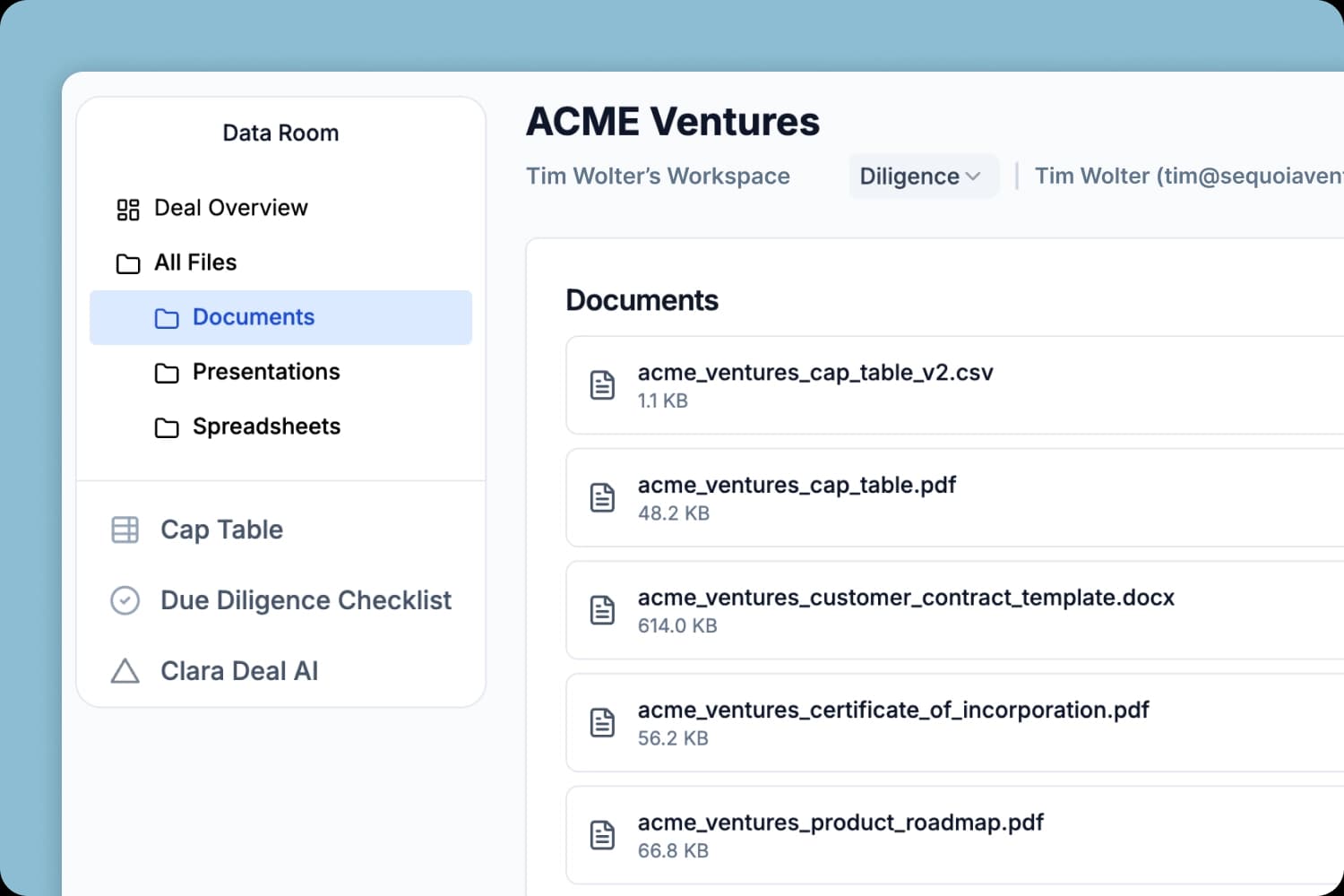
How to Model Waterfalls with DealVue in Real Time
Founders frequently sign unfavorable term sheets simply because modeling complex multi-tier liquidation waterfalls in Excel is intimidating and error-prone. One broken formula in a circular lookup table can distort payout estimates by millions.
DealVue Business ($79/mo) includes an institutional-grade Exit Waterfall Simulator built natively into your cap table:
- Interactive Valuation Slider: Slide from $1M to $500M and watch proceeds dynamically flow through senior debt, preferred liquidation preferences, accrued compounding dividends, and common distributions.
- Automatic Conversion Thresholds: DealVue automatically calculates the exact crossover valuation point where an investor mathematically maximizes their return by converting from preferred preference to common stock.
- Multi-Round Seniority Stacks: Configure seniority rankings between SAFE conversions, Series Seed, Series A, and Series B with custom participation caps and dividend rates.
The Founder's Term Sheet Negotiation Playbook
When prospective lead investors present you with a term sheet, remember that valuation is not the only number that matters. A $25M valuation with 2x participating preferred and 8% cumulative dividends is often worth far less to common shareholders than a $20M clean valuation with 1x non-participating preferred.
Follow these golden rules during term sheet negotiation:
Conclusion: Knowledge is Equity Protection
In venture capital, economic terms matter just as much as corporate governance. Understanding how liquidation preferences, participating rights, and compounding dividends function is not merely a legal formality—it is the foundation of protecting your life's work.
By modeling your capitalization structure in an institutional deal room platform like DealVue, you gain the mathematical clarity needed to negotiate from a position of absolute strength.
Model Your Exit Waterfall Today
Simulate liquidation preferences, compounding dividends, and dilution scenarios with DealVue Business.