
Most accelerator programs rely on an unstructured mix of gut instinct, mentor feedback, and scattered spreadsheets to evaluate which founders in a cohort are actually ready to pitch investors. While this approach might work for a small handful of startups, it breaks down completely when you try to scale.
As an ecosystem operator or accelerator director, you know the feeling all too well: Demo Day is approaching, but half the cohort still has glaring holes in their data rooms, while the other half has spent weeks agonizing over font choices rather than tightening up their go-to-market strategy. This misalignment leads to wasted mentor time, missed investment opportunities, and a frustrating experience for both founders and the investors evaluating them.
When accelerators scale, the traditional artisan approach to founder mentorship simply cannot keep up. You cannot clone your best mentors, nor can you personally review fifty data rooms every week. Accelerators need a scalable, objective, and data-driven way to measure founder readiness. They need a system that removes the guesswork from cohort management, allowing program directors to instantly identify which founders are ready to raise, which ones need a strategic intervention, and which ones are dangerously behind schedule. The shift from subjective evaluation to quantified readiness scoring is the most significant operational upgrade an accelerator can make to improve fundability outcomes, attract top-tier mentors, and maintain the trust of their Limited Partners.
The Problem with Subjective Measurement
The "I'll Know It When I See It" Fallacy
Ecosystem operators and accelerator program managers face a common, persistent challenge: subjective evaluation. Without a standardized framework to measure founder readiness, determining who gets access to top-tier investor introductions becomes a dangerous guessing game. Too often, readiness is judged based on the charisma of the founder or the visual appeal of a pitch deck, rather than the structural integrity of the business model and the completeness of the due diligence materials. This "I'll know it when I see it" mentality introduces inherent bias into the accelerator process, inadvertently penalizing founders who may have solid businesses but lack the polished presentation skills of their peers. It creates a system where flash is rewarded over substance, leading to embarrassing situations where a highly touted startup gets dismantled by an investor's first deep dive into their financials.
Mentor Whiplash and Conflicting Advice
Subjective measurement doesn't just hurt the evaluation process; it actively damages the mentorship experience. When readiness isn't objectively defined, mentors end up spending hours reviewing fragmented documents instead of focusing on strategic, high-level advice. Furthermore, founders frequently suffer from "mentor whiplash." On Tuesday, Mentor A tells the founder their financial model is too complex. On Thursday, Mentor B tells them it's not detailed enough. On Friday, Mentor C asks where the competitor matrix is. Without a single source of truth or a standardized baseline of what a "ready" data room looks like, founders spend their accelerator time running in circles trying to please conflicting opinions, rather than building a fundamentally sound business.
The Resource Allocation Trap
Programs struggle to track objective progress over the length of the cohort. When you have twenty or fifty startups in a batch, resources are strictly limited. Program directors need to know exactly where to deploy their EIRs (Entrepreneurs in Residence), legal counsel, and financial experts. If you don't know which startups are struggling with their cap tables versus those struggling with their customer contracts, you end up applying a one-size-fits-all curriculum that serves no one perfectly. This lack of structure not only hurts the founders by misallocating crucial support, but it also creates immense friction when producing LP reporting. Without quantifiable data, demonstrating the value and impact of the accelerator program becomes a narrative exercise of storytelling, rather than a data-driven reality that proves ROI.
Enter the Deal Readiness Score
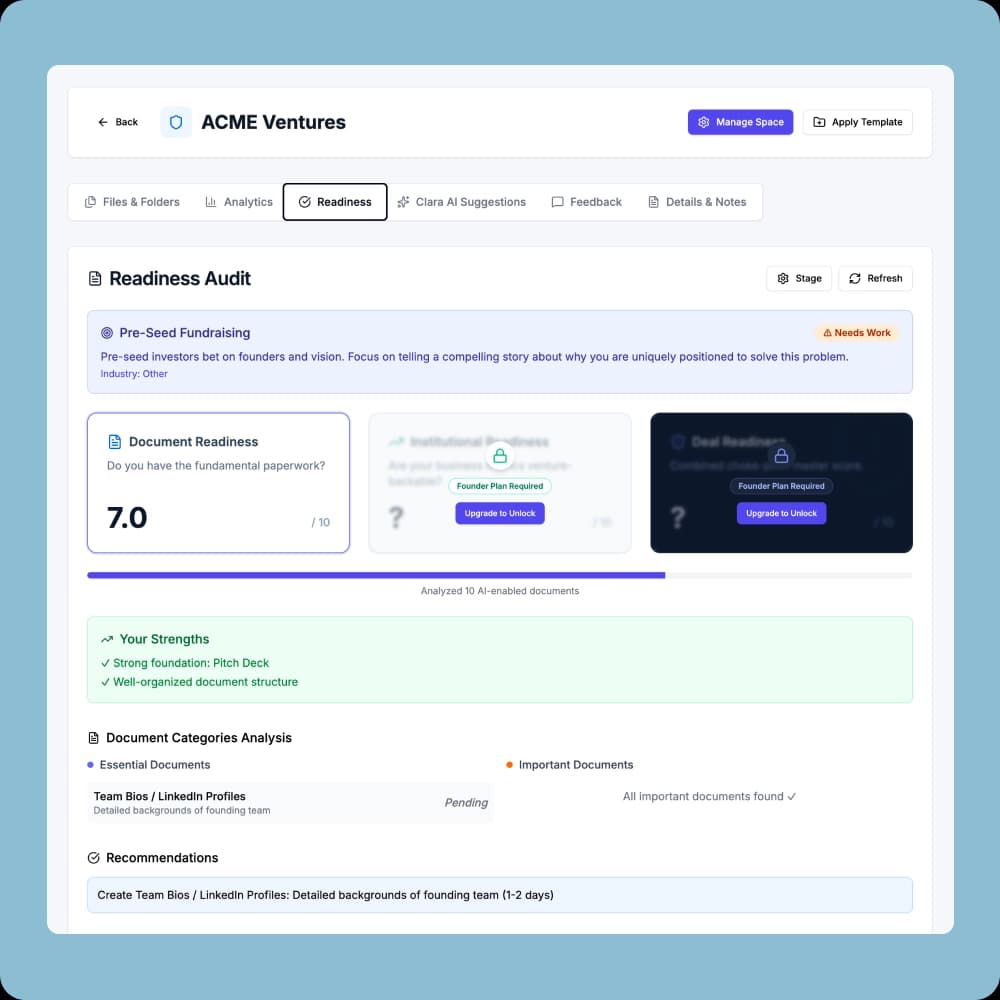
This is where DealVue's Deal Readiness Score comes in. It serves as the great equalizer and the ultimate diagnostic tool for accelerators. Instead of relying on subjective opinions and scattered Google Drive folders, the Deal Readiness Score provides a quantitative, weighted evaluation (from 0 to 10) of a startup's true investor readiness. This isn't an arbitrary number pulled out of thin air; it is calculated based on the rigorous standards that institutional investors use to evaluate seed and Series A deals. The Deal Readiness Score transforms a qualitative assessment into a hard metric that can be tracked, improved, and leveraged.
Deconstructing the 0-10 Framework
The scoring algorithm built into DealVue evaluates the completeness and quality of a startup's data room, automatically reviewing files, checking for missing critical documentation, and assessing the coherence of the materials provided. It weighs components based on their critical importance at a given stage of fundraising, breaking down the requirements into three distinct tiers that guide founders on exactly what to prioritize first. This structured approach eliminates mentor whiplash by providing a single, objective north star for the entire cohort.
60% Must-Haves: The Foundation of Fundability
To even get in the door with a serious institutional investor, certain documents are absolutely non-negotiable. DealVue weights these "Must-Haves" at 60% of the total Deal Readiness Score. These include the core materials that dictate the fundamental viability of the investment. Without these, the startup is simply not ready to raise capital:
- The Pitch Deck: Not just a slide deck, but a cohesive narrative that clearly defines the problem, solution, market size, and traction.
- The Cap Table: A clean, fully diluted capitalization table detailing all current shareholders, option pools, and convertible notes (SAFEs). Messy cap tables are the number one reason deals fall apart in late-stage diligence.
- The Financial Model: A detailed, assumption-driven 3-to-5-year financial projection that demonstrates how the company will use the injected capital to reach its next critical milestone.
- Corporate Governance: Articles of incorporation, bylaws, and basic IP assignment agreements ensuring the company actually owns what it claims to own.
30% Should-Haves: Derisking the Investment
Once the foundation is laid, founders need to provide the supporting evidence that derisks the opportunity for the investor. These "Should-Haves" make up 30% of the score and are what typically separate a fast pass from a slow "maybe." These documents prove that the business is operational and legally sound:
- Customer Contracts and Pipeline: Proof of traction via signed MSAs, letters of intent (LOIs), or a detailed CRM export showing a healthy, moving sales pipeline.
- Technical Architecture: Documentation outlining the tech stack, data flow, security protocols, and any technical debt that the investor needs to be aware of.
- Historical Financials: P&L statements, balance sheets, and cash flow statements from the past 12-24 months, proving fiscal responsibility.
- Key Employee Agreements: Employment contracts for the executive team, complete with vesting schedules and non-competes where applicable.
10% Nice-to-Haves: The Polish That Wins Competitive Deals
The final 10% of the Deal Readiness Score comprises the supplementary documents that add polish and depth to the diligence process. While an investor might not ask for these on the first call, having them ready demonstrates an elite level of operational maturity that builds immense trust and often wins competitive, oversubscribed rounds:
- Go-To-Market (GTM) Strategy Docs: Detailed playbooks for customer acquisition, CAC/LTV analysis, and marketing channel breakdowns.
- Product Roadmaps: Visual timelines of upcoming feature releases and how they tie into the overall strategic vision.
- Press and Media Coverage: Compiled links and PDFs of positive PR, industry awards, and thought leadership articles published by the founding team.
- Data Room Index: A perfectly organized, easy-to-navigate directory that makes the investor's job as easy as possible, demonstrating organizational competence.
Real-World Impact: Amplify Louisville
Scaling Ecosystem Support Across Kentucky
By applying a standardized Deal Readiness Score across an entire cohort, programs can instantly identify their breakout companies and intervene with those falling behind. A prime, real-world example of this methodology in action is Amplify Louisville (navigator.amplifystartups.com), a state-backed startup GPS supported by the Kentucky Cabinet for Economic Development. Amplify Louisville is tasked with an enormous mandate: to cultivate, support, and scale the technology ecosystem across the entire state of Kentucky, which requires managing hundreds of founders simultaneously across vastly different industries and stages of growth.
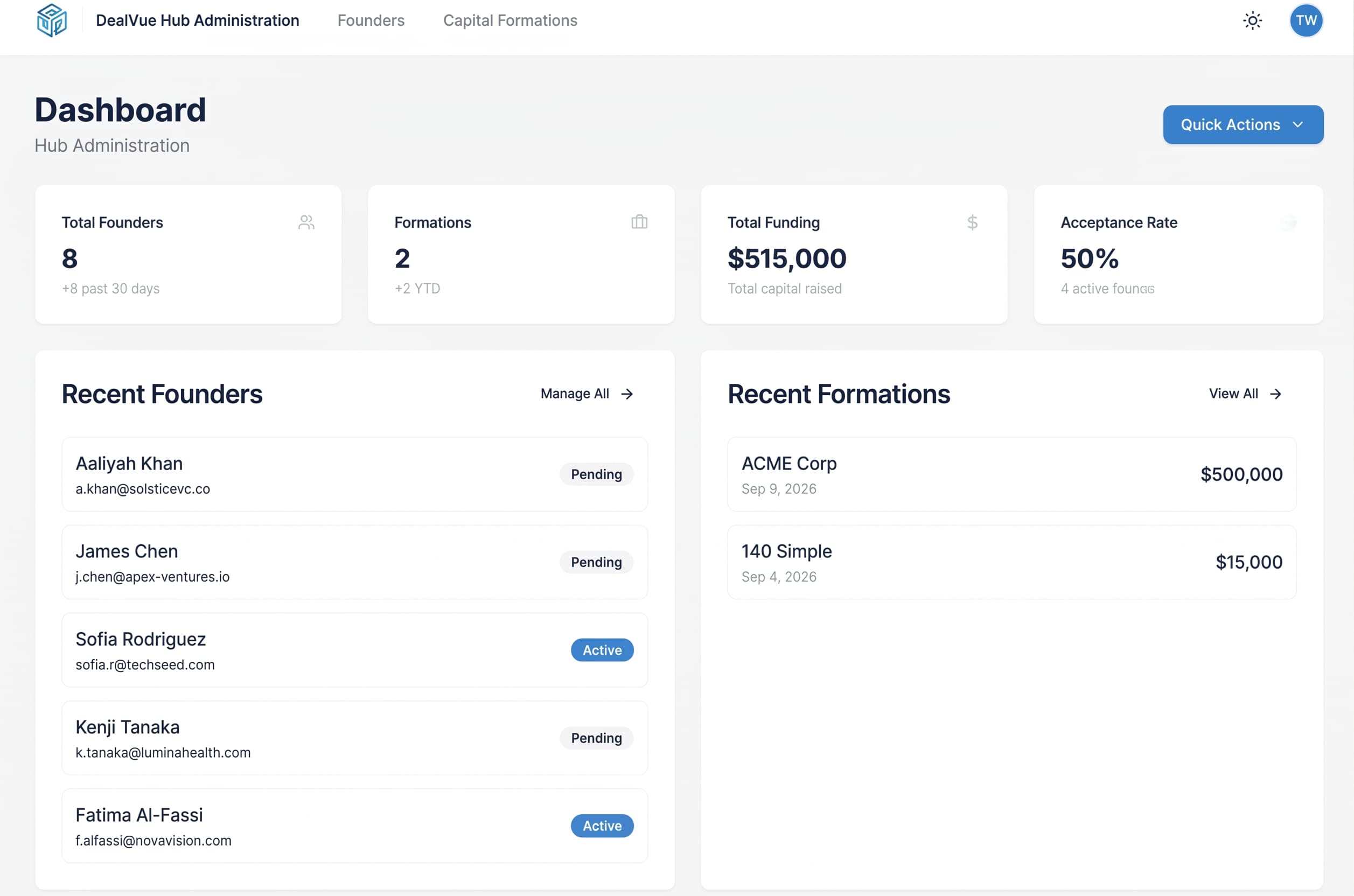
Amplify Louisville has guided over 320 startups across Kentucky, helping deploy over $67M in venture capital to early-stage founders. Managing a portfolio of this size using traditional spreadsheets, ad-hoc emails, and fragmented Google Drives would be an operational nightmare. Instead, by integrating DealVue's Hub infrastructure product for startup ecosystems, they have fundamentally transformed their support model. Every founder in the Amplify network receives a dedicated DealVue data room from day one, establishing a culture of readiness from the moment they enter the program.
VuePort Secure Sharing in Action
A critical component of this success is VuePort, DealVue's secure sharing technology. Once an Amplify Louisville founder achieves a high Deal Readiness Score, they don't just send a raw Dropbox link to an investor. They use VuePort to create a highly secure, trackable portal for their data room. Program directors can monitor these shares, ensuring that sensitive IP is protected while simultaneously tracking which investors are actually engaging with the materials. This transitions the accelerator from simply making warm intros to actively managing the deal flow pipeline with institutional-grade security.
Clara AI and the 7-Agent Analysis
This infrastructure enables program directors to continuously track cohort deal readiness at a granular level without adding headcount. This is largely powered by Clara AI, DealVue's sophisticated artificial intelligence system utilizing a 7-agent analysis framework. Working tirelessly in the background, Clara AI's agents—acting as virtual analysts, legal associates, and financial auditors—analyze the uploaded documents in real-time. They cross-reference cap tables for mathematical errors, evaluate financial models for unrealistic growth assumptions, and scan pitch decks to ensure the value proposition matches the financial projections.
As founders upload and refine their materials, Clara AI updates their Deal Readiness Score dynamically. This means Amplify Louisville directors no longer have to guess who is ready for a VC introduction. They can simply pull up their DealVue Hub dashboard, sort their 320+ startups by Deal Readiness Score, and direct their attention exactly where it is needed. High-scoring founders (e.g., those scoring 8.5 or above) are fast-tracked for investor matching, while founders stuck at a 4.0 are flagged for targeted mentor intervention regarding their missing "Must-Have" documents. This level of precision reduces wasted mentor time and ensures that when a founder is introduced to a venture capitalist, they are truly prepared to withstand institutional diligence.
Better LP Reporting and Outcomes
Moving from Anecdotes to Analytics
Quantified readiness scoring fundamentally changes program outcomes on a macro level, particularly when it comes to communicating with the people funding the accelerator itself. It transforms Limited Partner (LP) reporting from a subjective collection of heartwarming anecdotes into a rigorous, metric-driven showcase of cohort progress. Accelerators are under increasing pressure to prove their value-add to their LPs, corporate sponsors, and government backers. With DealVue, program managers can generate comprehensive reports that show the aggregate increase in readiness across the entire batch, definitively proving the program's impact.
Instead of saying, "Our founders worked really hard and improved a lot," accelerators can now state with objective certainty: "Our Fall Cohort entered the program with an average Deal Readiness Score of 3.5. After 12 weeks of targeted curriculum and mentorship, the cohort graduated with an average score of 8.9, representing a 154% increase in objective investor readiness. Furthermore, startups that achieved a score of 9.0+ closed their seed rounds 40% faster than the industry average." This is the kind of hard, undeniable data that secures follow-on funding for the accelerator itself and attracts higher-quality applicants for the next batch.
Predictive Insights via Engagement Analytics
Beyond immediate reporting, the Deal Readiness Score provides predictive insights that help accelerators optimize their future programming. By analyzing the Engagement Analytics provided by DealVue—which track exactly how often investors view specific documents, which pages of the pitch deck they linger on, and how long they spend in the data room overall—accelerators can reverse-engineer the diligence process. If the aggregate Engagement Analytics show that seed-stage investors are consistently spending 80% of their time scrutinizing the financial models and cap tables of SaaS startups, the accelerator can proactively adjust next season's curriculum to bring in more financial modeling experts earlier in the program.
Ultimately, measuring founder readiness at scale is about respecting everyone's time. It respects the founder's time by giving them clear, actionable goals rather than vague, conflicting advice. It respects the mentor's time by allowing them to focus on high-leverage strategic guidance rather than basic document hunting and formatting. And crucially, it respects the investor's time by ensuring that every deal that crosses their desk has already met a rigorous, standardized threshold of quality. In the highly competitive world of early-stage venture capital and startup ecosystems, the programs that adopt quantified readiness and AI-driven infrastructure will be the ones that consistently produce the most successful, fundamentally sound, and highly fundable companies.
Scale Cohort Readiness Across Your Ecosystem
Empower your accelerator, incubator, or venture studio with DealVue Hub infrastructure, real-time readiness scoring, and Clara AI.