
You just crushed your first meeting with a partner at a top-tier VC firm. The partner leans back, smiles, and says those fateful words: "This sounds really interesting. Send over your materials and we'll take a look." What happens next dictates whether you get a second meeting or get completely ghosted. Institutional VCs evaluate the materials you send, but more importantly, they evaluate how you present them.
Most founders scramble at this stage. They dump a pitch deck, an outdated cap table, and a half-baked financial model into a chaotic Google Drive folder. They tell themselves that the product speaks for itself and the data room is just administrative overhead. Institutional VCs expect substantially more. They expect an organized, professional investor data room that proves you are ready for their capital. When a partner opens your data room, they are implicitly asking themselves: "Is this founder organized enough to manage millions of dollars of our LP's money?"
Building a data room is not an administrative chore; it is a critical, strategic component of your fundraising process. A pristine data room builds trust, accelerates diligence, and maintains deal momentum. A sloppy data room introduces friction, breeds skepticism, and gives the investor an easy excuse to pass. Here is a comprehensive, actionable, step-by-step guide on how to build a data room that gets deals done, focusing specifically on the rigorous expectations of modern institutional investors.
Data Room Architecture: Guiding the Investor's Eye
A data room is not just a repository of files; it is a narrative device. The order in which you present your documents tells a story about your business priorities. Investors do not read data rooms like a novel from start to finish. They hunt for specific information to validate or invalidate the assumptions they made during your pitch. You need to architect the folder structure so their eye lands exactly where you want it to. Navigation must be entirely frictionless.
Structuring the Core Folders
You should always structure your data room into logical, sequentially numbered folders. This prevents investors from guessing where things are and forces an alphabetical sorting mechanism that maintains your desired order. A standard, VC-approved structure looks exactly like this: 01_Company_Overview, 02_Financials, 03_Legal_and_HR, 04_Product_and_Tech, 05_Go_to_Market. By numbering the folders, you actively control the cognitive sequence of the investor's diligence process. They start with the grand vision (the deck in folder 01), move to the execution metrics (financials in folder 02), and finish with the detailed diligence (legal in folder 03).
Inside the Company Overview folder, your executive summary and the latest pitch deck should be the most prominent, unmistakably labeled items. When VCs open the Financials folder, they expect to immediately see a structured Excel or Google Sheets model, not a massive PDF of a QuickBooks export. The organization itself is a leading indicator of your operational competence as a CEO. If your data room is chaotic and hard to navigate, investors will rationally assume your company's internal operations are equally chaotic.
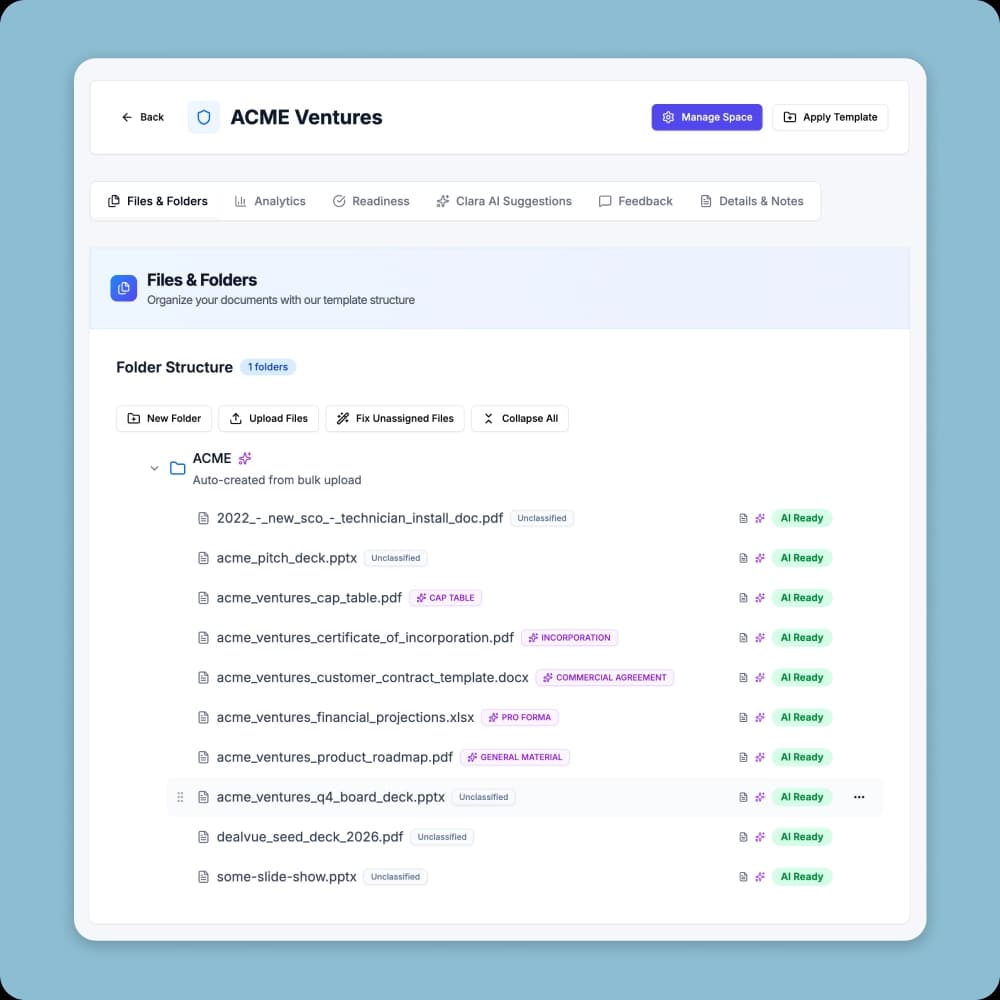
The Difference Between a "Document Dump" and a Fiduciary-Grade Data Room
Many first-time founders confuse a shared cloud folder with a true data room. A generic Google Drive or Dropbox link filled with loosely named files (e.g., "Deck_v7_Final_v2.pdf", "Copy_of_Financials_Q3.xlsx") is a document dump. It lacks structure, enterprise-grade security, and essential context. A fiduciary-grade data room, on the other hand, is a secure, curated environment designed specifically for high-stakes financial due diligence.
Security, Professionalism, and Watermarking
A fiduciary-grade room uses dynamic watermarking on PDFs, disables unauthorized downloads for highly sensitive legal documents, and tracks exactly who is looking at what and for how long. It presents a branded, highly professional interface that aligns with your company's aesthetic. When you use DealVue's VuePort, for instance, investors get a secure sharing environment that doesn't force them to create a new account or remember a frustrating password, yet it provides you with enterprise-grade security and granular access control. This level of professionalism signals that you are not just a hacker in a garage; you are a CEO ready for a Series A or Series B institutional round. It shows that you place a high value on your own proprietary data, forcing the investor to treat it with the same level of respect.
Deeper Coverage of the 5 Most Common Mistakes
Even experienced, repeat founders make critical errors when assembling their diligence materials. Avoid these five deal-killing mistakes, which occur far more frequently than you might think and can torpedo an otherwise promising fundraise:
1. The Missing Executive Summary
Investors often share your materials internally with other partners who were not in the initial pitch meeting. A crisp, 1-2 page executive summary is absolutely crucial for these asynchronous evaluations. Without it, you are forcing an uninitiated, busy partner to parse a 20-slide visual deck just to understand the basic premise of what you do. Always include an executive summary memo that explicitly covers the problem, the solution, the Total Addressable Market (TAM), recent traction, and team backgrounds.
Specific Example: Instead of just hoping they infer the market size from a chart on slide 7, explicitly state your TAM and SAM in the first paragraph of the memo. Make it easy for the associate to copy and paste your summary directly into their internal investment memo.
2. The Wrong Cap Table Format (The PDF Trap)
Providing a static PDF or a messy, hard-coded spreadsheet for your cap table is a massive red flag. Institutional investors need to run complex scenario models on your cap table to understand their potential ownership, pre-money vs. post-money valuations, and founder dilution under different exit scenarios. Provide a clean, formula-driven cap table that clearly outlines the fully diluted share count, the unissued option pool, and all historical funding instruments (like SAFEs and convertible notes).
Specific Example: If a VC has to email you to ask, "Does this total outstanding share count include the 15% post-money option pool we discussed?", your cap table has failed its primary purpose. Everything must be explicit.
3. No Financial Model or Excel-Only Historicals
If you only provide historical profit and loss statements and no forward-looking financial model, you are failing to show the investor how their specific capital injection will be deployed. Conversely, if your model is overly complex, riddled with circular references, and relies on hardcoded assumptions hidden in random cells, it becomes entirely unusable. Provide a 3-5 year monthly projection model with a clear, isolated "Assumptions" tab for revenue drivers and major cost centers.
Specific Example: Ensure that if a VC changes the "Cost per Click" assumption on the master dashboard, that change flows correctly through the entire P&L, automatically updating the projected cash runway. This proves you understand the mechanics of your business.
4. The Pitch Deck Is Not Current
Sending a deck that features outdated metrics, a different fundraising ask than what you verbally discussed in the meeting, or old team members who have since left is exceptionally sloppy. Always ensure the deck in the data room is the exact, polished version you presented, or an explicitly labeled "read-ahead" or "appendix-heavy" version that expands on the live presentation.
Specific Example: If your deck says you are raising $2M at an $8M cap, but in the meeting you confidently stated you are raising $3M at a $12M cap because you are oversubscribed, the discrepancy in the data room will cause immediate confusion and erode trust.
5. Unexplained Missing Documents
If you lack a standard diligence document, such as an IP assignment from an early offshore contractor, hiding the omission is the absolute worst strategy. Provide a placeholder document explaining the situation clearly.
Specific Example: Include a short memo titled "03_IP_Assignment_Context.pdf" detailing that the specific contractor worked for exactly two weeks in 2021, only wrote frontend CSS, and the code has since been completely rewritten by internal staff. Proactive transparency builds enormous trust; intentional omission destroys it permanently during legal diligence.
Access Control Strategy: Who Gets What
Not all investors should get the exact same level of access on day one. A junior associate doing preliminary market screening needs entirely different information than a general partner writing a binding term sheet. Granular access control is essential for maintaining your leverage during a competitive fundraise.
Tiered Access and NDA Gating
Think of your data room in distinct access tiers. The foundational Tier 1 contains the pitch deck, the executive summary, and high-level historical financials. This is what you immediately send after the first meeting to maintain momentum. As the relationship progresses and they signal deeper diligence intent, you grant access to Tier 2: the detailed formulaic cap table, individual employee agreements, massive customer contracts, and sensitive IP assignments.
Crucially, use NDA gating for highly sensitive documents, such as unannounced enterprise contracts or proprietary source code architecture. DealVue allows you to set permissions at the specific folder level, ensuring that competitors masquerading as investors cannot easily scrape your most valuable data. This tiered approach heavily protects your confidential information and allows you to accurately gauge the investor's true level of interest based on exactly what access tier they request.
Timing and Upkeep: Managing the Room
Building a data room is absolutely not a one-time, set-and-forget event; it requires diligent ongoing maintenance. The timing of when you initially build it and how you update it can significantly impact the overall speed and success of your fundraise.
When to Build (Hint: Not the Night Before)
Never attempt to build your data room the night before you launch your fundraise or the morning after an investor asks for it. The process of gathering these critical documents will invariably reveal hidden gaps in your business—a missing founder signature here, a broken financial formula there. You need at least three to four dedicated weeks before your first pitch to assemble, rigorously audit, and refine the data room contents.
Updating Without Breaking Links
As you progress through your multi-month fundraise, you will hit new operational milestones. You might close a massive new enterprise customer or significantly update your financial projections for the new quarter. It is absolutely crucial to be able to seamlessly update documents in the data room without having to email a new Google Drive link to fifty different investors, which causes version control chaos. Modern, purpose-built platforms like DealVue allow you to seamlessly swap out the underlying file in the backend, ensuring that everyone who opens the link always sees the most current, single source of truth without any broken URLs.
The Second Meeting Follow-up: Using Engagement Analytics
The modern data room is not just a passive storage facility; it is a powerful intelligence-gathering tool that should directly inform your outbound follow-up strategy.
Identifying Who Is Still Warm
After you send the VuePort link, monitor the engagement analytics obsessively. If a VC firm has multiple partners logging in simultaneously, and they are spending significant, concentrated time in the Financials and Legal folders, they are clearly leaning toward a "yes." You should prioritize them in your follow-ups, perhaps offering a technical deep-dive call.
Conversely, if a partner asks for the room, opens the deck for exactly thirty seconds, and never returns to the link, they are highly likely a "no." Do not waste valuable founder time writing lengthy follow-up emails to chase them. Use the analytics to identify the warm leads and drive them aggressively toward a second meeting and, ultimately, a term sheet.
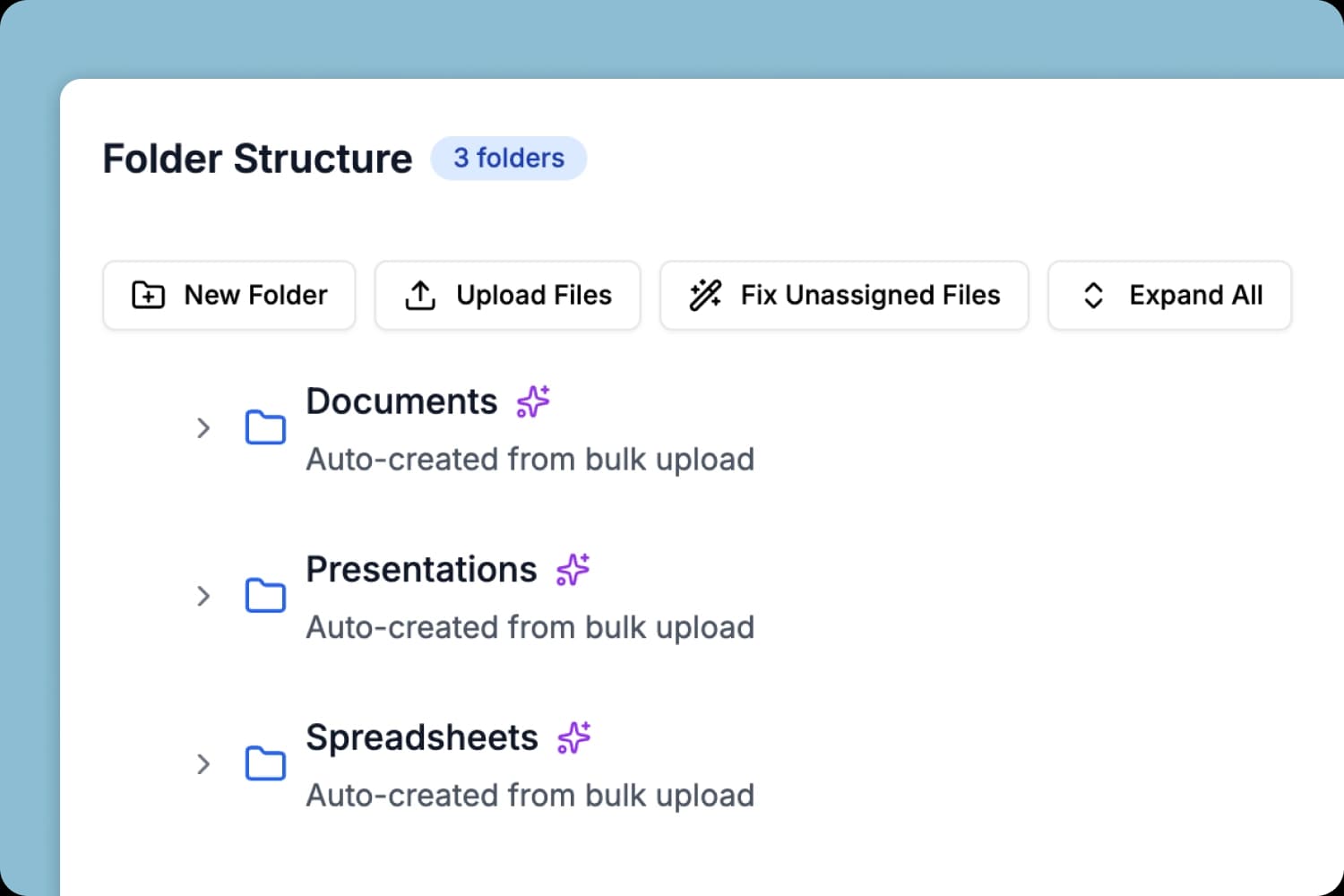
The 60/30/10 Weighting Framework
When assembling your data room, use the proven 60/30/10 framework to ruthlessly prioritize your effort. DealVue evaluates your room based on this exact operational model:
- 60% Must-Haves: The core documents that are absolute deal-breakers if missing. This includes the pitch deck, financial model, cap table, and foundational incorporation documents. Spend the vast majority of your time perfecting these items.
- 30% Should-Haves: Documents that provide strong signals of operational maturity, such as customer case studies, organizational charts, and detailed product roadmaps. These separate the good startups from the great ones.
- 10% Nice-to-Haves: Additions that provide extra momentum and social proof, like press clippings, notable advisor agreements, and non-binding letters of intent.
How Clara AI and the Deal Readiness Score Help Close the Gap
Knowing exactly what goes in a data room is only half the battle. Knowing objectively if your specific documents are investor-ready is the other, much harder half. That's exactly where DealVue comes in.
Instead of constantly wondering if your data room is complete, DealVue's Deal Readiness Score automates the diligence gap analysis for you. Our proprietary Clara AI utilizes 7 distinct AI agents to comprehensively analyze your uploaded documents against a heavily weighted checklist of what institutional VCs expect for your specific stage (from Pre-seed through Series B).
Within minutes, Clara proactively flags missing documents, highlights incomplete data, and warns you of potential red flags. It gives you a clear score from 0 to 10, highlighting exactly what you need to fix before you ever share your VuePort link with a real investor. It transforms the highly subjective anxiety of fundraising preparation into a clear, actionable, mathematical checklist.
By faithfully following this comprehensive guide and leveraging intelligent, purpose-built tools like DealVue, you will confidently present a data room that commands respect, massively accelerates the diligence process, and significantly increases your chances of securing that crucial second meeting.
Ready to build an investor-ready data room?
Get your data room audited by Clara AI in minutes and share institutional VuePort links with confidence.