
Few moments in the life of a venture-backed founder produce more acute anxiety than receiving an email from a prospective lead investor with the subject line: "Quick follow-up: can you send over your full capitalization table?"
On one hand, this request represents substantial progress. Institutional venture capital firms do not spend time scrutinizing capitalization structures for companies they intend to pass on. A cap table request typically signals that your pitch passed the initial partner screen and is moving into preliminary financial diligence.
On the other hand, your capitalization table is the single most sensitive, confidential document in your entire organization. It contains the raw, unvarnished blueprint of your corporate power dynamics: exact co-founder equity percentages, early executive option grants, salary sacrifice agreements, angel investor check sizes, and historical valuation milestones.
If handled clumsily, sharing this document prematurely or through insecure channels can ignite co-founder friction, demoralize key engineers, compromise your upcoming valuation negotiations, or leak proprietary compensation data to competing firms.
This playbook provides founders with an authoritative, battle-tested framework for sharing capitalization records safely during institutional due diligence, outlining the 3-Stage Staged Disclosure Protocol, the mortal dangers of unredacted Excel models, and how modern Application-Level Encryption (ALE) and Scoped Stakeholder Portals protect founder privacy.
The Horror Stories: Why Founders Are Rightfully Paranoid
Many first-time founders assume that venture capitalists are bound by strict legal confidentiality agreements. In reality, virtually no Tier-1 VC firm will sign a non-disclosure agreement (NDA) before evaluating an early-stage startup. In an ecosystem where firms review thousands of pitch decks annually, signing NDAs would paralyze their investment operations and expose them to frivolous copyright litigation.
Because you are sharing materials without a legal NDA safety net, operational security is your only true defense. Consider three very common real-world disasters that occur when founders email unredacted equity spreadsheets:
1. The "Unhide Columns" Catastrophe
A seed-stage SaaS founder prepares an Excel cap table for a prospective lead fund. To protect their early engineers' exact salaries, the founder simply right-clicks columns D through G (which list cash compensation and equity strike prices) and selects "Hide." They email the `.xlsx` file directly to the venture associate.
The associate opens the file, presses `Ctrl + A`, right-clicks, and clicks "Unhide." Within seconds, the venture fund possesses the exact cash and equity breakdown of every employee in the company. Two months later, the fund passes on the deal, but their portfolio company (a direct competitor) begins aggressively poaching the startup's lead machine learning engineers with finely calibrated 20% compensation bumps.
2. The Disgruntled Co-Founder Leak
When early startups launch, co-founder equity splits are frequently uneven due to differences in technical contribution, prior capital invested, or full-time versus part-time commitment. In the early days, this split might be mutually agreed upon in private.
However, when an unredacted cap table is shared loosely across an angel syndicate or prospective angel investor network, those numbers leak. If junior team members or newly hired VP-level executives discover that one co-founder holds 42% while another holds 18%, internal resentment can quickly metastasize into toxic culture wars and executive departures during the fundraise.
3. Compromised Valuation Leverage
If a prospective VC discovers exactly how much runway you have left from your historical SAFE notes, or sees that your previous angel round closed at a lower valuation cap than you pitched during your partner meeting, your pricing leverage evaporates. The fund knows your exact financial pain point and calibrates their term sheet discount accordingly.
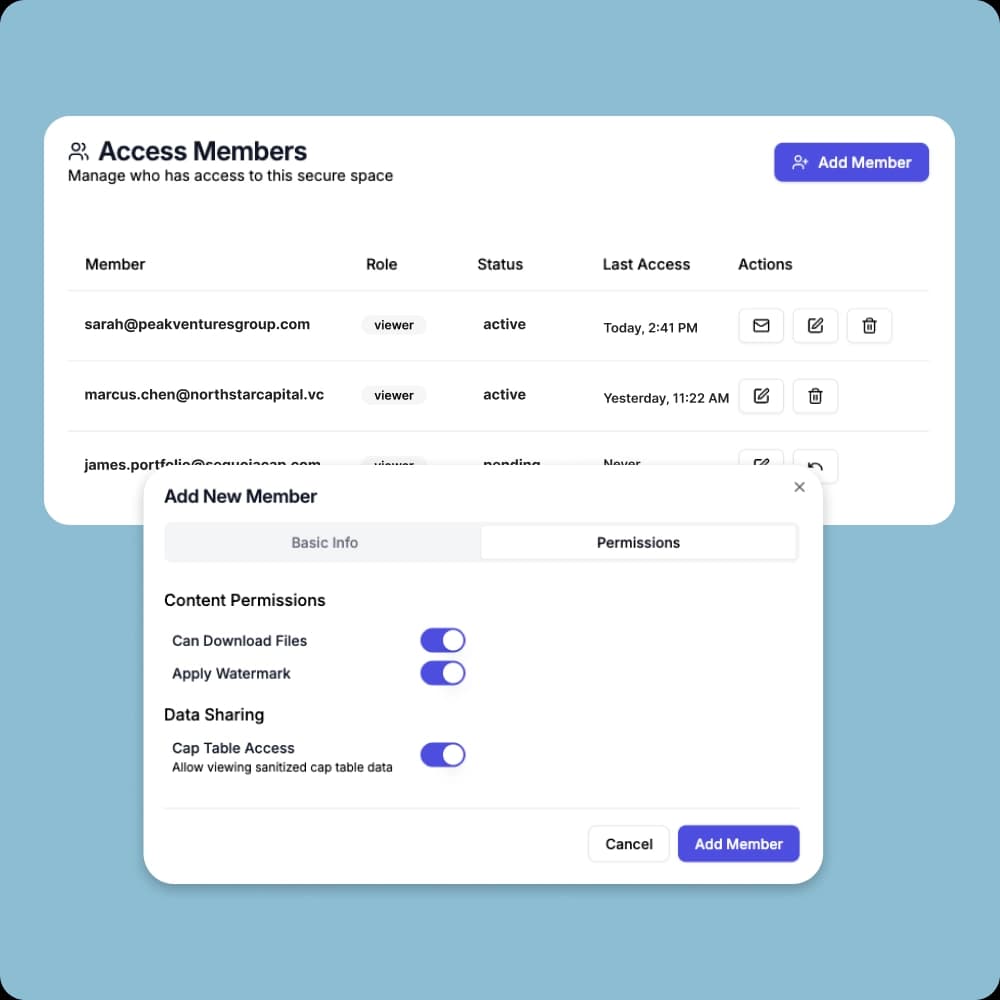
The 3-Stage Staged Disclosure Protocol
To balance the investor's legitimate need for diligence information against the founder's imperative for corporate privacy, institutional founders follow a Staged Disclosure Framework. You never dump your full, line-by-line stakeholder cap table on day one. Instead, you disclose data progressively as investor commitment deepens:
The 3-Stage Cap Table Disclosure Framework
Stage 1: High-Level Capitalization Summary (First Meeting / Screening)
Included in your read-ahead deck or preliminary VuePort data room. Share high-level pie charts and aggregated categories (Founders 65%, Unallocated Pool 12.5%, Prior SAFEs 18%). No individual names, specific salaries, or personal check sizes are disclosed.
Stage 2: Anonymized Share Class Matrix (Deep Diligence / Partner Meeting)
Shared after a successful second partner meeting. The fund receives an anonymized breakdown: 'Founder 1 (CEO)', 'Founder 2 (CTO)' with vesting schedules, aggregated option grants by engineering tier, and SAFEs grouped by valuation cap tranche without individual investor names.
Stage 3: Full Line-by-Line Legal Closing Ledger (Term Sheet Signed)
Strictly after a formal Term Sheet has been negotiated and signed. Shared inside a restricted, dynamically watermarked DealVue folder accessible only to verified external legal counsel for confirmatory diligence.
The Technical Architecture: Application-Level Encryption (ALE)
Most legacy data room and cap table tools rely entirely on standard database encryption-at-rest. Under that model, data is encrypted when written to the physical storage disk, but sits in clear plaintext whenever it is read by the application server or queried by database administrators.
DealVue was engineered with an enterprise-grade Application-Level Encryption (ALE) pipeline to guarantee that confidential equity data remains mathematically isolated:
- AES-256-GCM Encryption: Sensitive stakeholder fields—including legal names, tax identification numbers, physical addresses, share quantities, strike prices, and SAFE investment totals—are encrypted in application memory prior to database insertion.
- Deterministic Blind Indexing: To allow founders to search their cap table without decrypting database records, DealVue creates deterministic HMAC-SHA256 hashes for exact-match lookups.
- Ephemeral In-Memory Decryption: Data is decrypted strictly in isolated server memory during authorized user sessions, ensuring that database snapshots and cloud backups contain zero plaintext equity data.

Scoped Stakeholder Portals: Eliminating Co-Founder & Angel Anxiety
Another critical vulnerability of traditional equity software like Carta or Pulley is their legacy access model. In many configurations, granting an angel investor or an employee access to view their electronic stock certificates exposes the global cap table, showing them who else invested, how many shares other executives hold, and total capitalization.
DealVue solves this with Scoped Stakeholder Portals:
- Individual Stakeholder View: When an angel investor logs in, their dashboard displays only their specific SAFEs, convertible notes, or preferred shares, their personal investment amounts, and their estimated payout scenarios.
- Zero Leakage of Peers: The angel investor cannot see the names, check sizes, or terms of any other investor on the cap table.
- Protected Employee Option Grants: Employees can view their granted option count, vesting cliff, vested percentage, and strike price without gaining visibility into their peers' packages or co-founder equity splits.
Dynamic Anti-Leak Watermarking & The Instant Kill Switch
Even with staged disclosure and encrypted data rooms, there is always the lingering threat of an unauthorized recipient taking screenshots or forwarding sensitive materials to unauthorized third parties.
DealVue protects every document and cap table export through active visual deterrence:
- Dynamic Anti-Leak Watermarking: Every time a venture capitalist opens your cap table summary or diligence document in DealVue's secure viewer, their registered email address, IP address, and exact viewing timestamp are diagonally tiled across the screen. If a viewer takes a screenshot or screen recording, their identifying credentials are permanently burned into the image, eliminating the incentive to leak.
- 1-Click Global Kill Switch: If negotiations terminate, or if a fund demonstrates hostile intent, a founder can revoke access in one click. Link tokens are immediately invalidated across global edge servers within milliseconds—locking out viewers even if they currently have the tab open on their machine.
Checklist: Sharing Your Cap Table Without Risk
Before sending equity materials to any prospective investor, run through this five-point pre-flight checklist:
Conclusion: Control the Diligence Narrative
Fundraising is an asymmetric negotiation. When you control your data, you control your leverage. By moving away from vulnerable, unencrypted spreadsheets and adopting a rigorous, staged disclosure framework with Application-Level Encryption, you protect your company's most sensitive intellectual property while projecting institutional maturity to prospective investors.
With DealVue, you no longer have to choose between transparency and security. You can deliver institutional cap table clarity with the confidence that your proprietary records are protected by military-grade encryption.
Protect Your Cap Table Today
Start sharing your capitalization records with Application-Level Encryption, dynamic watermarks, and Scoped Stakeholder Portals.