
Preparing for investor due diligence can feel overwhelming. What documents do you actually need? What are the deal-breakers if missing? How do you organize hundreds of files so that a VC partner can quickly find what they need to write a term sheet?
We've compiled the ultimate data room checklist based on what institutional VCs actually look for. Rather than a flat list, we structure this around the DealVue 60/30/10 weighting framework. This tells you exactly where to spend your time: Must-Haves (60%), Should-Haves (30%), and Nice-to-Haves (10%).
The Must-Haves (60% Weight - The Deal Breakers)
These are non-negotiable. Without these, your deal will stall immediately. Investors use these documents to validate the core claims made in your initial meeting.
1. Pitch Deck (Presentation & Read-Ahead)
Investors look for the exact narrative you presented. Include the clean presentation version and an appendix-heavy "read-ahead" version that answers anticipated diligence questions. A common mistake is leaving outdated metrics in the deck that conflict with your financial model. The pitch deck isn't just about pretty slides; it is the strategic roadmap of your entire business. Investors want to see consistency in your story from the first slide to the last appendix chart.
2. Executive Summary (1-2 Pages)
A concise memo outlining the problem, solution, market size, traction, and team. Investors share this internally with partners who weren't on the pitch call. If you don't provide it, an associate will write one for you—and they might get the story wrong. It should act as a standalone document that perfectly summarizes why this deal is a must-do for the fund.
3. Financial Model (3-5 Year Projections)
A bottom-up, driver-based Excel model. Investors want to see how you think about growth, customer acquisition costs, and headcount scaling. Hardcoded revenue numbers with no underlying formula logic are an instant red flag. They will stress-test your assumptions. If your customer acquisition cost is modeled to drop by 50% next year, you need a compelling operational reason why.
4. Historical Financial Statements
Profit & Loss (P&L), Balance Sheet, and Cash Flow statements for the past 2-3 years (if applicable). Investors look for clean accounting and cash management competence. They want to see that you understand your burn rate and that historical spending aligns with the narrative you've told about your company's past growth phases.
5. Current Cap Table
A clean spreadsheet showing all founders, employees, and past investors. It must explicitly show the fully diluted share count and the unallocated option pool. A messy cap table signals future legal headaches. Specifically, VCs look for a clean SAFE/equity breakdown, absolutely no surprise advisors holding large chunks of equity without providing ongoing value, and they want to ensure there is no founder vesting cliff that has already passed, which might incentivize a founder to walk away post-funding.
6. Incorporation Documents
Articles of Incorporation, Certificate of Good Standing, and any historical amendments. VCs need to ensure the entity actually exists and is properly formed (usually a Delaware C-Corp for US startups). This is a basic hygiene check, but failing it immediately pauses all other diligence until fixed.
7. IP Ownership & Assignment Agreements
Proof that the company actually owns the intellectual property created by the founders and employees. Missing IP assignments from early contractors is a frequent deal-killer during legal diligence. Every line of code, every design, and every patent must be cleanly assigned to the corporate entity.
8. Founding Team Bios & Key Contracts
Detailed backgrounds of the leadership team and their employment agreements. Investors invest in people; they want to verify your domain expertise and ensure key players have standard vesting schedules. They will cross-reference these bios against LinkedIn profiles to ensure consistency.
The Should-Haves (30% Weight - Operational Maturity)
These documents prove you are operational, have real traction, and are thinking strategically about the future. They separate the amateurs from the professionals.
1. Customer References and Case Studies
A list of 3-5 customers willing to speak to the VC, accompanied by written case studies showing ROI. Investors will always ask for back-channel references, but providing front-channel champions speeds up the process.
2. Go-to-Market (GTM) Strategy & CAC Analysis
Detailed breakdown of your Customer Acquisition Cost, Lifetime Value (LTV), and sales cycles. This shows that your growth is systematic, not accidental.
3. Product Roadmap (12-24 Months)
A clear timeline of upcoming features and architectural shifts. This proves that you have a vision beyond the current product and understand how the new capital will unlock specific milestones.
4. Organizational Chart
A visual map of current employees and planned hires. Investors use this to see if your hiring plan aligns with your financial model's headcount projections.
5. Major Supplier or Vendor Agreements
Contracts for essential software (AWS, APIs) or physical suppliers. VCs want to check for concentration risk—if one supplier shuts you down, the company dies.
6. Technology Architecture Overview
A diagram or memo explaining your tech stack, security posture, and data flow. For deep-tech or AI companies, this is critical to prove defensibility.
The Nice-to-Haves (10% Weight - The Cherry on Top)
These items provide additional momentum, social proof, and validation that can push a hesitant investor to conviction.
1. Letters of Intent (LOIs)
Signed but non-binding agreements from large prospects. This shows future revenue potential and market demand, even if the product isn't fully ready.
2. Press Coverage and PR
Links to TechCrunch articles, Forbes mentions, or industry podcast appearances. It signals that you know how to generate earned media and build brand awareness.
3. Competitor Analysis & Battlecards
A realistic evaluation of incumbents and other emerging startups. Don't claim you have no competitors; VCs hate that. Instead, clearly show why your product is 10x better in a specific, growing vertical.
4. Testimonials and User Feedback
Unsolicited screenshots of tweets, G2 reviews, or Slack messages from obsessed users. This brings subjective passion to the objective data in your room.
5. Detailed Cap Table Scenario Modeling
A pro-forma model showing expected dilution for this round, unissued option pool expansion, and subsequent Series A assumptions. DealVue allows you to model these dilution waterfalls natively.
6. ESG and Diversity Policies
Increasingly required by institutional LPs for Tier-1 VC funds. Having a written policy shows broad-minded corporate governance from day one.
7. Exit Strategy and Comparables
A brief analysis of recent M&A transactions or IPOs in your category. Helps the VC formulate the "How big can this get?" section of their internal investment memo.
8. Patent Filings and Defensive Publications
If applicable, any provisional patents, defensive publications, or trademark registrations that solidify your proprietary moat.
9. Board of Directors / Advisory Minutes
Summaries of past quarterly board meetings or advisor syncs. Proves that you already operate with standard corporate governance and can manage a board.
What About What's Missing?
No early-stage company has all 23 documents ready on day one. That's completely expected by investors. The critical mistake is not having missing documents; it's ignoring them and hoping the VC won't notice.
The Placeholder Strategy
Never just leave a folder empty or omit a required document without explanation. Use a placeholder strategy. If you do not have a formal ESG policy or audited financials, include a document titled "Context_Audited_Financials.pdf" that simply states: "As a Pre-seed company incorporated 6 months ago, we do not yet have audited historical financials. We rely on our internal cash flow statements provided in Folder X."
In these cases, you can use DealVue's Investor Memo auto-generation tools to draft these explanations automatically. This approach explicitly addresses the missing document, showing the investor that you are aware of standard diligence requirements but have a valid reason for the omission. It turns a potential red flag into a demonstration of competence.
Having Documents vs. Having Investor-Ready Documents
There is a profound difference between checking a box and passing due diligence. You might have a cap table, but is it investor-ready? You might have a financial model, but does it clearly isolate the key assumptions?
Investor-ready documents are designed to be consumed by a skeptical third party. They are clearly formatted, heavily annotated, and logically sound. They anticipate questions. A standard document requires the VC to ask follow-up questions to understand it. An investor-ready document answers the follow-up questions proactively. Strive for the latter, and your deals will close significantly faster.
Score Your Checklist with DealVue
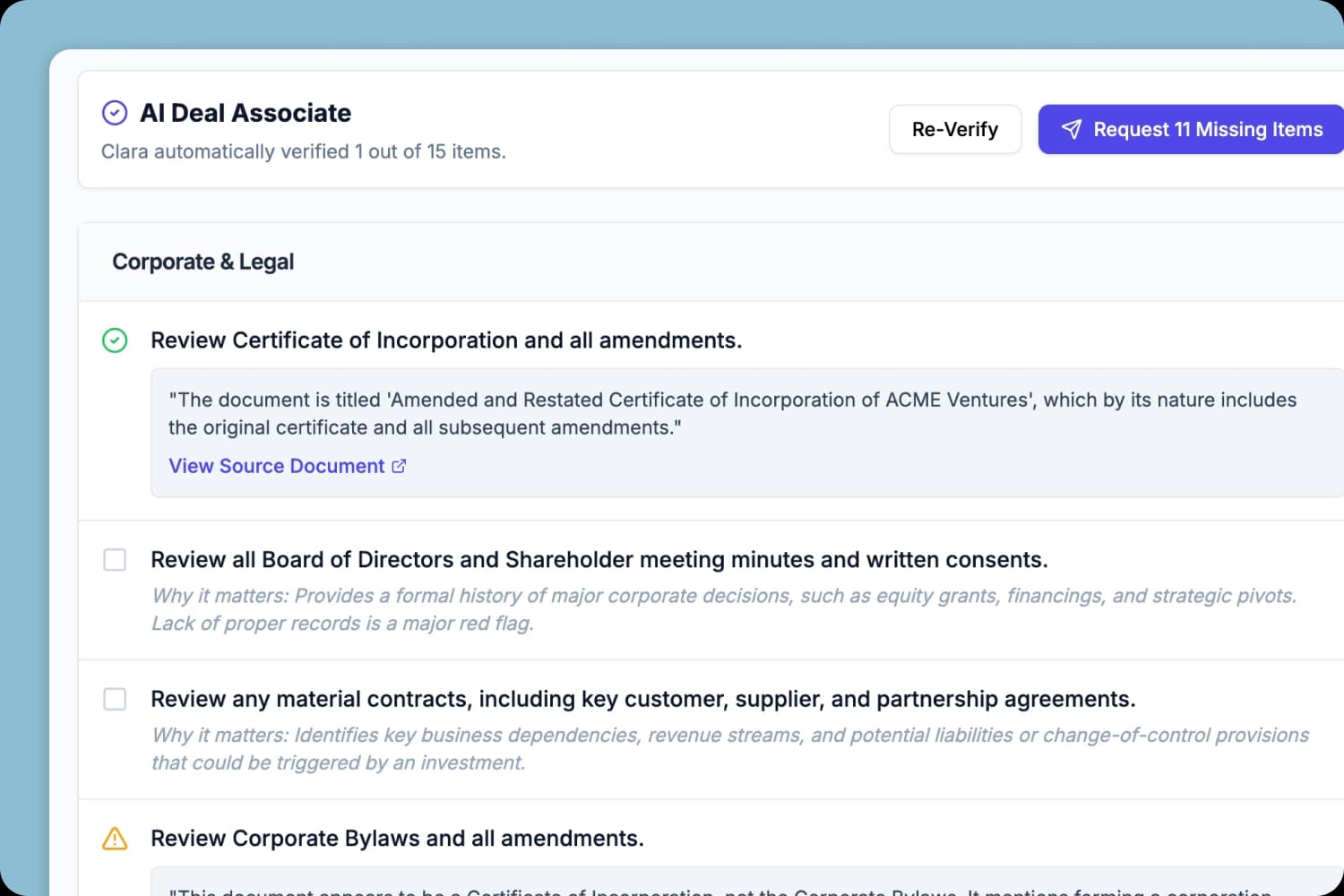
Manually checking off these 23 items is tedious, and you still might not know if your financials are structured the way VCs want. If you miss a crucial Must-Have, you trigger an immediate red flag that can kill the deal.
DealVue's Deal Readiness Score acts as an intelligent, automated checklist. Clara AI maps your uploaded documents against this exact 60/30/10 standard, grading your readiness on a 0-10 scale. Instead of stressing over what you missed, let DealVue analyze your room and give you a clear score—and actionable feedback—before you share it via a secure VuePort link with investors. By evaluating not just the presence of a document, but its quality and consistency, DealVue ensures you always present a fiduciary-grade data room.
Furthermore, DealVue's continuous monitoring means that as you update your materials over a multi-month fundraising sprint, your Deal Readiness Score updates dynamically, ensuring you never inadvertently introduce a red flag.
You don't need to guess if you are ready. You can know with certainty. That confidence translates into better pitches, smoother negotiations, and ultimately, a higher valuation. Take control of your diligence process today.
In the high-stakes environment of venture capital, the prepared founder wins. Equip yourself with the right tools, follow the 60/30/10 framework, and build a data room that accelerates your deal rather than stalling it.
Remember that every interaction with a VC is a test of your execution capabilities. The data room is often the most comprehensive test they will administer. Passing it with flying colors requires more than just good intentions; it requires systematic, uncompromising preparation.
Score your data room checklist with DealVue
Don't guess if you're investor-ready. Get your materials analyzed by Clara AI against the 60/30/10 standard.