
For years, ecosystem operators—state agencies, Community Development Financial Institutions (CDFIs), university innovation centers, and technology accelerators—have operated on a fundamentally similar model. They provide ambitious founders with experienced mentorship, a modicum of early-stage funding or grant capital, and a lengthy list of resources, then hope for the best.
Across the globe, governments and local municipalities are pouring record amounts of capital into economic development and innovation hubs. Whether fueled by federal initiatives like the State Small Business Credit Initiative (SSBCI) or localized job creation grants, the mandate is clear: nurture high-growth startups to drive economic transformation. Yet, despite this influx of support, the connective tissue that bridges a promising early-stage company to its first institutional check is often missing. Instead of providing founders with the structural scaffolding they need to organize their business, programs typically hand them a dense directory of SaaS discounts, service providers, and scattered templates. The missing piece isn't more advice; it's a persistent, standardized infrastructure layer that embeds best practices directly into the startup's daily operations.
Historically, ecosystems have treated the data room as an afterthought—a static repository hastily assembled in the final weeks before a critical Demo Day or a high-stakes investor meeting. But modern startup ecosystems require a fundamentally different approach. They require an infrastructure layer that acts as the single source of truth for every portfolio company, enabling seamless data sharing, robust cohort analytics, and a frictionless pathway for local and national venture capital. This is why every modern startup ecosystem needs a data room infrastructure layer from day one.
The Problem with the Resource List Approach
When founders are simply handed a checklist of what they need to build an investable company, they are left to stitch together disparate tools on their own. This fragmented approach is not just inefficient; it actively hinders a startup's ability to raise capital and scale operations effectively. A list of resources, no matter how comprehensive, shifts the burden of organizational design entirely onto the shoulders of first-time founders who are already stretched thin trying to find product-market fit.
The Fragmentation Toll on Early-Stage Founders
In the absence of a unified infrastructure platform, founders inevitably resort to a patchwork of disconnected software solutions. They might use one generic cloud storage provider for document archiving, a separate CRM or spreadsheet for tracking investor engagement, another specialized platform for organizing their cap table, and fragmented email threads for communicating critical updates to their advisors. This decentralized mess creates severe operational friction.
Consider the toll this takes during a due diligence process. When an investor asks for updated financial models, historical board minutes, and a clean cap table, a founder relying on a patchwork system must spend days or even weeks tracking down the latest versions, verifying their accuracy, and securely sharing them. This delay can kill momentum in a fundraising round. Time kills all deals, and a fragmented approach to data management is one of the primary culprits of delayed or failed raises.
- Version Control Chaos: Founders frequently send outdated financial models or pitch decks to investors, creating immediate red flags regarding their operational competence.
- Security Vulnerabilities: Generic link-sharing tools lack the granular access controls and engagement tracking necessary to protect sensitive intellectual property and financial projections.
- Operational Drag: Hours that should be spent speaking to customers, refining the product, or closing sales are instead wasted on administrative document hunting and formatting.
Blind Spots for Program Directors and Operators
The resource list approach doesn't just hurt founders; it creates massive blind spots for ecosystem operators, accelerator directors, and CDFI administrators. When every startup in a cohort uses a different set of tools and organizational methods, it becomes virtually impossible for program managers to standardize tracking and evaluate progress accurately.
Program directors are often reduced to relying on self-reported surveys or anecdotal check-ins to gauge how a startup is progressing. They ask questions like, "Is your data room ready?" or "How many investors are currently in diligence?" without having any verifiable data to back up the founders' optimistic answers. This lack of visibility prevents operators from intervening when a startup is struggling with compliance, missing critical legal documents, or failing to engage with investors effectively. Without a shared infrastructure layer, ecosystem operators are flying blind, unable to provide the targeted, data-driven support that can mean the difference between a startup thriving or shutting down.
The Persistent Data Room
The solution to this fragmentation and lack of visibility is a persistent, evolving data room that follows the founder from the idea stage all the way through their Series A raise and beyond. An accelerator data room shouldn't just be a repository of files created right before Demo Day. It should be the single most important founder artifact—a living representation of the company's health, compliance, and readiness to absorb institutional capital.
From Static Files to Living Artifacts
A persistent data room fundamentally shifts the concept of due diligence from an episodic event to a continuous state of operational readiness. Instead of treating the data room as a chore to be completed when an investor expresses interest, founders using a structured infrastructure layer treat it as the central nervous system of their business.
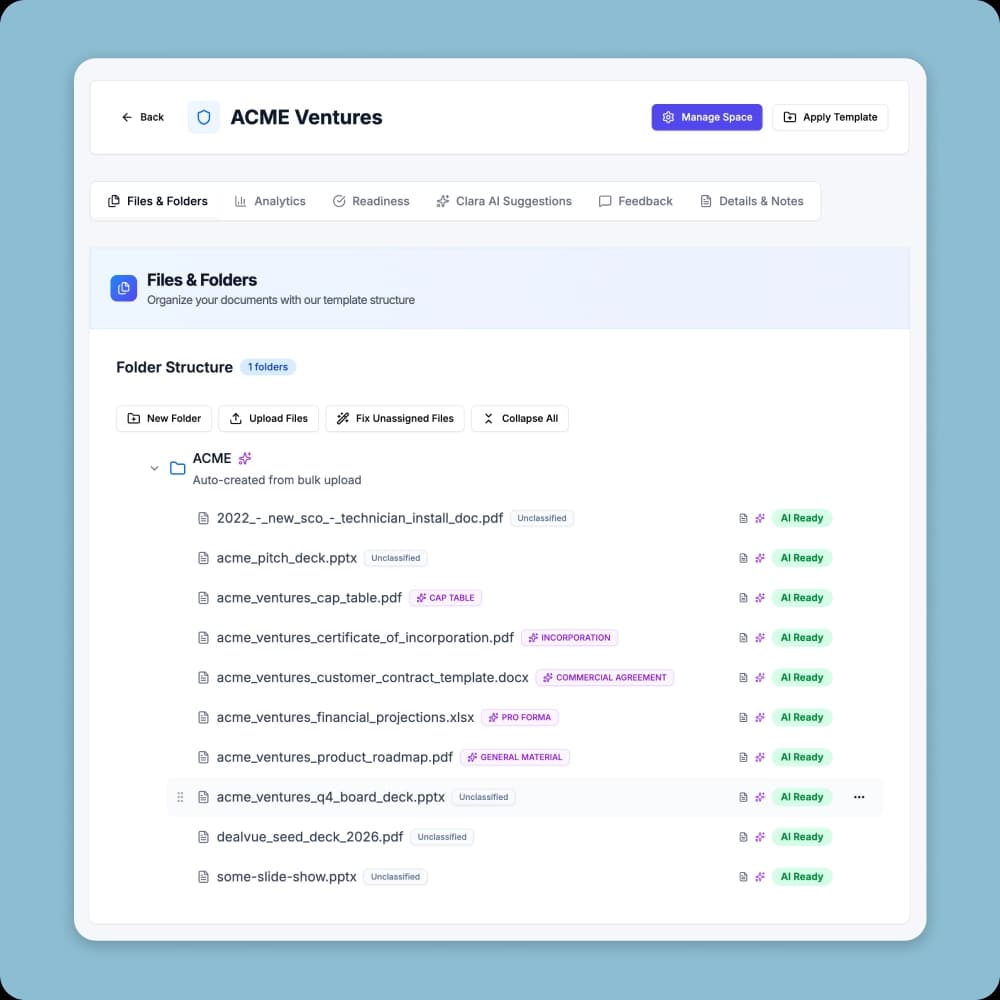
This living artifact contains perfectly categorized folders for corporate governance, intellectual property, financial models, human resources, and technical architecture. Every time a new patent is filed, a key employee agreement is signed, or a monthly financial close is completed, the document is immediately uploaded and categorized. This continuous habituation ensures that when an investor requests access, the founder can grant it instantly, projecting an image of extreme competence, transparency, and organizational maturity.
Building Operational Muscle from Day One
By providing a data room from day one, ecosystem operators fundamentally change how founders operate. Founders learn early on how to structure their business information cleanly, making the eventual due diligence process seamless rather than a frantic scramble. This is about building operational muscle memory. When a founder is introduced to a structured data environment early, they internalize the expectations of institutional investors.
They begin to understand why separating common and preferred stock documents matters, why intellectual property assignment agreements must be signed by every contractor, and how detailed their financial projections need to be. The data room infrastructure layer acts as a silent mentor, guiding the founder toward best practices through its very architecture. This proactive approach significantly reduces the failure rate of startups during the diligence phase, ensuring that promising companies aren't derailed by easily avoidable administrative errors.
Unlocking Ecosystem Analytics and Deal Flow
When an entire ecosystem operates on a shared infrastructure layer, the benefits extend far beyond the individual founder. The true power of a standardized data room platform reveals itself at the macro level, transforming how accelerators, state programs, and innovation hubs measure success and connect startups with capital.
Aggregate Cohort Analytics and LP Reporting
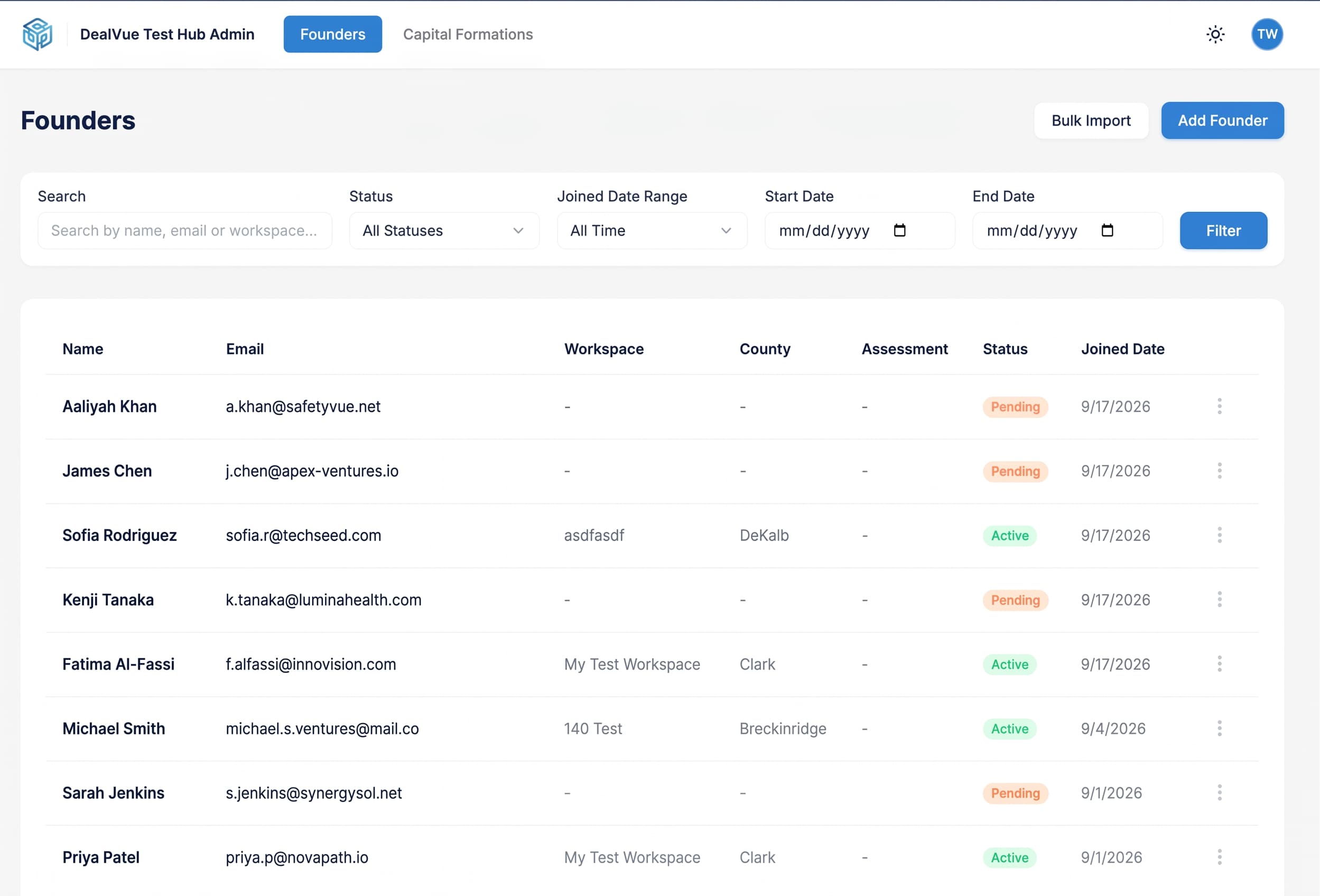
For program directors, CDFI leaders, and state economic development officials, this infrastructure enables powerful, real-time cohort analytics. You can finally move away from lagging indicators and self-reported surveys. Instead, you can view aggregated, anonymized data across your entire portfolio to see exactly how companies are progressing. You can track how many startups have completed their financial models, identify which companies are actively uploading monthly investor updates, and see where the cohort as a whole is struggling to meet compliance standards.
Furthermore, a standardized data room infrastructure dramatically simplifies Limited Partner (LP) and stakeholder reporting. Whether an ecosystem is accountable to state legislators, corporate sponsors, or philanthropic foundations, being able to point to hard, verifiable data regarding the progression and readiness of the portfolio is invaluable. Programs can prove their impact by demonstrating that their companies are operationally sound, legally compliant, and actively engaging in due diligence with verified investors. This transparency is crucial for securing subsequent rounds of funding for the accelerator or ecosystem program itself.
Bridging the Gap Between Local Capital and Deal Flow
Crucially, this infrastructure streamlines deal flow to local and national investors. One of the biggest hurdles in emerging startup ecosystems is bridging the gap between local capital—such as family offices, regional angel networks, and early-stage micro-funds—and the startups themselves. Investors are inherently risk-averse, and a disorganized, unprofessional due diligence process is often a massive deterrent, particularly for investors operating outside of traditional tech hubs like Silicon Valley or New York.
When venture capitalists and angel investors know that startups graduating from your program are using a standardized, highly secure data room infrastructure, their confidence in those deals immediately increases. They know that the legal documents will be in order, the cap table will be clean, and the financial models will be accessible. This standardization reduces the friction of investment, shortens the time-to-close, and accelerates the flow of capital into the ecosystem.
Case Study: Scaling Statewide Impact with Amplify Louisville
To understand the transformative power of a dedicated infrastructure layer, we can look at the tremendous success of regional programs that have embraced structured founder support. A prime example of this model in action is Amplify Louisville, a powerhouse organization driving startup growth across the region.
Deploying $67M+ with Structured Infrastructure
Amplify Louisville operates as a vital hub for entrepreneurs, backed significantly by the Kentucky Cabinet for Economic Development. Their mandate is expansive: provide strategic guidance, crucial resources, and deep connectivity to help startups secure capital and scale rapidly. They recognized early on that simply introducing founders to investors was not enough; the founders needed to be rigorously prepared to pass institutional due diligence.
By integrating robust structural support and data readiness into their methodology, Amplify Louisville has been able to guide more than 320 startups through the treacherous early stages of company building. This isn't just about casual mentorship; it's about ensuring that every company is investment-ready when they step into the room with a VC. The results of this rigorous, infrastructure-first approach speak for themselves.
- Massive Capital Deployment: Startups supported by Amplify Louisville have successfully secured and deployed over $67 million in venture capital.
- Accelerated Diligence: Because founders are taught to maintain pristine data and documentation, investors can move through due diligence faster and with higher confidence.
- Statewide Economic Impact: The success of these startups translates directly into high-paying jobs, technological innovation, and significant economic growth for the state of Kentucky, proving the ROI of the Kentucky Cabinet for Economic Development's backing.
The Amplify Louisville case study proves that when ecosystem operators move beyond simple resource lists and instead mandate rigorous, structured data readiness, the entire region benefits. They have established a blueprint for how state-backed programs can generate massive, outsized returns by focusing on the infrastructural readiness of their founders.
The DealVue Hubs Model: Co-Branded Ecosystem Infrastructure
Recognizing the critical need for this standardized layer, we developed the DealVue Hubs model. It is designed specifically to be this foundational infrastructure layer for accelerators, university programs, CDFIs, and state-backed economic development initiatives. It is not just another software tool; it is a comprehensive platform designed to elevate the entire ecosystem.
Co-Branded Deployments for Maximum Ecosystem Alignment
By embedding DealVue's secure data room and advanced founder tooling directly into your program's platform through a co-branded deployment, you provide a seamless, frictionless experience for founders, mentors, and investors alike. The infrastructure feels native to your program, reinforcing your brand's value while delivering enterprise-grade technology.
Through powerful features like VuePort—our proprietary secure sharing links—and granular Engagement Analytics, founders can intelligently manage their investor outreach. They can see exactly which investors are viewing their pitch decks, how much time is being spent on their financial models, and which documents are being ignored. This allows founders to follow up with precision and close rounds faster.
Simultaneously, program operators maintain complete oversight of the ecosystem's overall health, deal readiness, and cohort performance. You transform your ecosystem from a loose collection of startups into a highly structured, data-driven engine of innovation and investment. The era of the fragmented resource list is over; the era of ecosystem infrastructure has arrived.
Modernize Your Startup Ecosystem Infrastructure
Equip your founders with institutional data rooms, real-time readiness scoring, and co-branded investor portals.