
When you send a VC your data room, they aren't just reading your documents. They are critically evaluating your execution, organization, and transparency as a leader. A messy, chaotic data room is interpreted as a direct proxy for a messy, chaotic company.
Founders often falsely assume that if their initial pitch was strong enough, the data room is just a legal formality. This is a fatal misconception. The data room is where the real, unvarnished due diligence begins, and where fragile deals go to die. Understanding the underlying psychology of what investors actually look for can mean the difference between an inbound wire transfer and a polite, boilerplate rejection. It is the invisible battleground of venture capital fundraising, where every detail matters.
The First 90 Seconds: What They Open First
Investors are notoriously time-poor. When they open your DealVue VuePort link, the clock starts ticking. Data shows that the first 90 seconds determine if they will spend the next two hours digging in, or if they will bounce entirely. The exact sequence in which they view your materials is highly predictable and deeply revealing about their core priorities.
The Executive Summary and Deck
The very first thing an associate or partner clicks is the Pitch Deck or the Executive Summary. Why? Because they need to immediately recall the narrative from your meeting, or they are a new partner who needs a crash course in 60 seconds. If they have to hunt through a folder named "Miscellaneous" to find the deck, you've already lost credibility. The deck acts as the map for the rest of their diligence journey. If the map is clear, they proceed with confidence. They will scrutinize the deck to ensure that the compelling story you told verbally is faithfully represented in writing.
The Quick Financial Sniff Test
The second document opened is almost always the financial model. They aren't checking your line-by-line marketing spend yet. They are checking for structural integrity. Are there hardcoded revenue numbers? Is there a clear assumptions tab? If the model looks like it was built by a professional, they relax. If it looks like a spaghetti bowl of #REF! errors, their skepticism skyrockets immediately. They want to know if the ambitious growth claims from the deck are backed by sane math. An elegant financial model demonstrates that you possess a rigorous, quantitative understanding of your business levers.
The Cap Table Scan
Next, they check the cap table. They are looking for "dead equity" (e.g., a co-founder who left with 30% of the company 6 months in) and checking the size of the unallocated option pool. A messy cap table kills deals faster than almost anything else because it represents complicated, expensive legal cleanup. VCs hate surprises here. They want to ensure that the active founding team is sufficiently incentivized to grind for the next 7 to 10 years to build a massive outcome.
The Five Deadly Red Flags That Kill Deals Immediately
Diligence is primarily an exercise in de-risking. Investors are actively looking for reasons to say "no" so they can clear their desks and focus on the tiny fraction of deals they will actually fund. If any of these red flags appear in your room, your deal is in immediate jeopardy:
1. Missing IP Assignment Agreements: If an early contractor, agency, or former employee wrote core code but never signed an intellectual property assignment agreement, the startup doesn't legally own its own product. No reputable VC will wire money into an entity with clouded IP ownership. It is an instant deal-breaker.
2. The Mysterious Founder Loan: When an investor opens the balance sheet and finds an unexplained $250,000 "Loan to Shareholder," alarms go off. Unorthodox financial arrangements signal poor corporate governance and a lack of fiduciary maturity.
3. Inconsistent Metrics Across Documents: If your pitch deck claims $1.2M in Annual Recurring Revenue (ARR), but your QuickBooks profit and loss statement shows $800k in recognized revenue, you have an enormous credibility problem. VCs verify everything. Inconsistencies suggest you are either intentionally misleading them or simply incompetent.
4. Unrealistic, Unsophisticated Projections: Projections that show revenue going from $50k to $100M in two years with zero increase in marketing spend or engineering headcount demonstrate a profound lack of operational reality. Sophisticated investors want ambitious targets, but they must be grounded in believable unit economics.
5. Broken Links and "Request Access" Walls: Nothing frustrates a VC more than hitting a "You Need Permission" screen at 11:00 PM on a Sunday while they are trying to write an investment memo. Use a dedicated platform like DealVue for smooth access management that doesn't rely on cumbersome Google Drive permissions.
The Psychology of Friction vs. Fluency
Cognitive fluency is the human tendency to prefer things that are easy to think about. When an investor opens a data room that is cleanly organized, beautifully structured, and fast to parse, their brain experiences low cognitive friction.
Every time an investor has to search for a file, guess what an obscure acronym means, or ask you for clarification on a poorly labeled spreadsheet, their cognitive load increases. High cognitive load breeds suspicion. Low cognitive load breeds confidence and trust. You want your data room to feel effortless to navigate, projecting an aura of inevitability about your ultimate success.
Cognitive Load and Trust Signals
Imagine a scenario where a VC asks for your customer churn analysis. In a standard Google Drive setup, you might email back a standalone CSV file two days later. In a "Clara-passing" data room, that analysis is already waiting for them in the "05_Go_to_Market" folder. By perfectly anticipating their needs, you signal that you are a founder who sees around corners. You remove cognitive friction, making it psychologically easier for them to write the check.
How Engagement Analytics Reveal Investor Intent
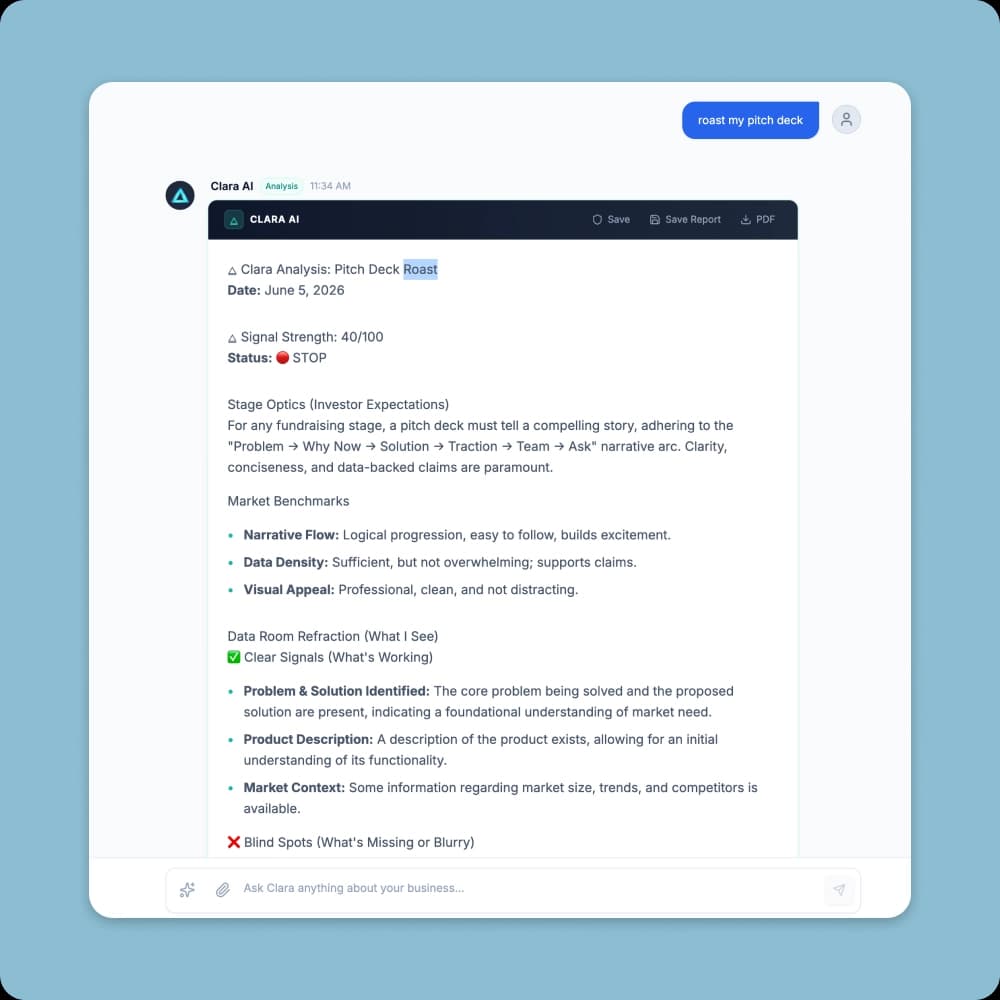
In the past, you sent an email with attachments and waited in agonizing silence, wondering if they even opened the zip file. Today, modern platforms provide real-time engagement analytics. When you use DealVue, you aren't just sharing files; you are gathering intelligence that can shape your entire fundraising strategy.
Decoding Analytics Behaviors
If an investor spends 20 minutes on your cohort retention analysis, you know exactly what to highlight in your follow-up email. Engagement behaviors are highly predictive of outcomes. By paying close attention to these signals, founders can efficiently allocate their time and energy toward the investors most likely to issue a term sheet.
Re-opens: If an investor re-opens the data room multiple times over a week, they are likely sharing it internally and building a case for investment. They might be bringing in a technical partner to review your architecture or an operations partner to review the GTM strategy. Multiple re-opens strongly indicate that the firm is actively debating the deal.
Long time on financials: If they spend an hour deep in your financial model, they have moved past the narrative phase and into serious diligence mode. This is a very strong buy signal. It means the partner believes the market is large enough and is now actively trying to validate the unit economics.
No re-open: If they open the room, look at the deck for 12 seconds, and never return, you know they are likely a "soft no" and you shouldn't waste time chasing them. Engagement analytics turn the data room from a passive storage drive into an active sales tool, allowing you to run a highly optimized fundraising process.
Institutional VCs vs. Angel Investors
It is critical to deeply understand who is reviewing your data room. Different investor classes have entirely different diligence frameworks and expectations. Presenting the wrong level of detail to the wrong audience can rapidly stall momentum.
The Angel Perspective
Angel investors might skim your deck, look at the cap table to ensure the founders have enough equity, and write a check based on personal conviction, team dynamics, and market momentum. They are investing their own money and can make decisions rapidly based on gut feel and personal rapport. For an angel, the data room is often just a final sanity check rather than the core battleground of the deal.
The Institutional Perspective
Institutional VCs operate completely differently. They have strict fiduciary duties to their Limited Partners (LPs). Their analysts and associates will aggressively dig into your employee vesting schedules, run complex sensitivity analysis on your financial model, and scrutinize your IP assignments. A data room that easily satisfies an Angel will often completely fail the rigorous stress-test of an institutional VC. VCs care deeply about market size, unit economics, and cap table cleanliness, requiring extensive documentation for each. They need concrete proof, not just optimistic promises.
The "Invisible" Things Investors Check
Beyond the obvious content, VCs are looking for hidden signals of competence and honesty. These are the invisible checks that founders rarely think about, but which heavily influence the final investment decision.
Document Metadata and Version Consistency
Sophisticated investors check document metadata. Did you create this financial model three months ago and just manually change the date, or was it built fresh for this round? Do the numbers magically match across all documents? If your deck claims a $500 CAC but the model specifically calculates it at $850, you have failed the consistency check. This suggests poor internal communication or, worse, intentional deception. They will also look at author metadata to see if the founder actually built the model, or if it was entirely outsourced to an agency.
Response Time to Follow-up Questions
How you handle specific questions about the data room is part of the diligence process. If an investor asks for a clarification on the cap table and it takes you four days to respond, it signals that you lack a firm grasp of your own metrics. Rapid, precise responses indicate operational excellence. It shows that you have the data at your fingertips and are actively managing the business, not just pitching it.
Common Founder Mistakes That Signal Unpreparedness
Even when the underlying business is exceptional, presentation errors can derail a fundraise. Avoid these common pitfalls that scream "amateur hour" to experienced venture capitalists.
The 5 Instant Red Flags
1. Inconsistent Numbers: Absolute synchronization between your narrative and your data is mandatory. Discrepancies kill trust instantly. If your revenue projections in the deck do not perfectly match the final row in your Excel model, the investor will assume you do not know your numbers.
2. The Missing Cap Table: Not including a cap table, or providing a messy, non-formulaic PDF, is a massive warning sign. If they can't see the fully diluted share count, they literally cannot price the round or understand their potential ownership stake.
3. No Financial Model (or a "Revenue-Only" Model): A spreadsheet that only shows top-line revenue without projecting costs, hiring plans, and cash burn is not a financial model—it is just a wish list. Investors need to clearly see the mechanical relationship between capital deployed and revenue generated.
The Difference Between a Good Deal and Great Execution
A brilliant product alone will not secure funding if the execution of the fundraise is flawed. Investors are not just evaluating the current state of your technology; they are evaluating your capability to execute complex operations under pressure.
The data room is the first tangible, complex operation you execute collaboratively with your future board members. A good deal with poor execution in the data room often gets heavily renegotiated, resulting in lower valuations or onerous terms. A great deal with great execution sails through diligence, resulting in a clean, founder-friendly term sheet. By obsessing over the details of your data room, you are actively protecting your valuation.
The DealVue Solution: From Google Drive to "Clara-Passing"
A standard Google Drive folder is just a bucket for files. It doesn't tell you if you are missing a critical IP assignment. It doesn't watermark your highly confidential financial model. It certainly doesn't provide granular engagement tracking to inform your follow-up strategy. Relying on generic cloud storage for a multi-million dollar transaction is a massive operational risk that founders no longer need to take.
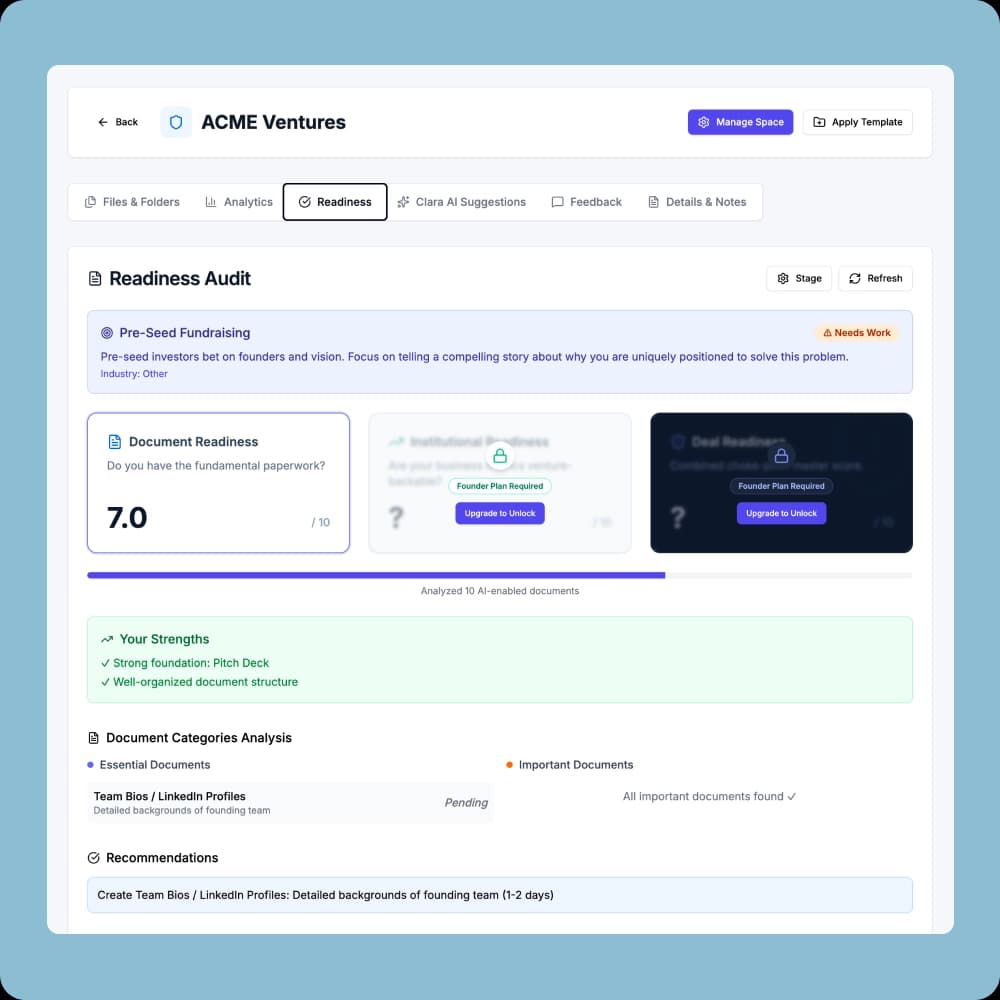
A "Clara-passing" data room is entirely different. DealVue's Clara AI analyzes your room and objectively ensures it meets the rigorous 60/30/10 standard expected by top-tier funds. By presenting a professional, heavily watermarked, and completely secure VuePort link, you send the ultimate credibility signal. You demonstrate that you treat your company's data with the utmost respect and security.
When you use DealVue, you aren't just barely meeting expectations; you are aggressively exceeding them. You are tangibly demonstrating that you understand the rigorous requirements of institutional capital and respect the time of the partners evaluating your business. A flawless data room allows the investor to focus entirely on the massive upside potential of your business, rather than being distracted by administrative hiccups.
Make the investment in your data room infrastructure before you desperately need it. The founders who raise successfully are the ones who treat the fundraising process as a professional, highly organized sales pipeline, backed by unimpeachable, perfectly organized data. Do not let a disorganized folder cost you the capital you strictly need to build the future.
The standard has been permanently raised. A great pitch gets you in the door. A flawless data room gets you the term sheet.
Build a data room that gets term sheets
Get your data room audited by Clara AI in minutes and share fiduciary-grade VuePort links.